Shanghai Library: History, Collections, Architecture, and Importance
Introduction
The Shanghai Library is one of the most important public libraries in China and an influential center for education, research, culture, and historical preservation. Located in Shanghai, one of the world’s largest and most dynamic cities, the library serves millions of readers, researchers, students, and visitors. More than a traditional place for borrowing books, Shanghai Library is a major cultural institution that connects people with knowledge, historical documents, digital resources, and international scholarship.
Shanghai has developed into an important global center for finance, business, science, technology, education, and culture. In such a rapidly changing city, the Shanghai Library plays an important role in preserving the intellectual heritage of the past while providing resources for the future. Its collections include books, newspapers, periodicals, manuscripts, maps, photographs, genealogical records, and many other forms of historical and contemporary information.
The library is particularly valuable because of its extensive Chinese-language collections and its important materials related to Shanghai’s history. It also provides resources that help researchers study Chinese society, literature, history, art, genealogy, and many other subjects.
History of Shanghai Library
The history of Shanghai Library is closely connected with the development of modern libraries and public education in Shanghai. The institution developed through the integration and growth of several earlier library collections and cultural institutions.
Shanghai has a long history as a center of international exchange. During the nineteenth and twentieth centuries, the city became an important meeting point for Chinese and foreign communities. As education, publishing, journalism, and scientific research expanded, the demand for libraries and organized collections of knowledge also increased.
The development of public libraries in Shanghai reflected these changes. Libraries were established to provide readers with access to books, newspapers, magazines, and educational materials. Over time, collections grew significantly, and different institutions accumulated valuable historical documents.
Modern Shanghai Library emerged from this long tradition. Its development involved the incorporation of important collections and library resources, creating a major institution capable of serving the city’s rapidly growing population.
The library’s history demonstrates how cultural institutions can evolve alongside a city. Shanghai transformed from a regional port into a global metropolis, and its library system expanded to meet the changing educational and research needs of its residents.
The Modern Shanghai Library
The modern Shanghai Library is more than a building filled with books. It functions as a comprehensive information and cultural institution.
Its services support several groups, including:
- Students
- Teachers
- University researchers
- Historians
- Writers
- Journalists
- Genealogists
- Professionals
- General readers
- International researchers
The library provides access to physical collections as well as electronic databases and digital resources. This combination allows users to study both traditional printed materials and modern forms of information.
One of the institution’s important characteristics is its role in preserving Shanghai’s cultural memory. Historical newspapers, rare books, manuscripts, maps, photographs, and other materials can provide researchers with evidence about how Shanghai and Chinese society changed over time.
Location and Architecture
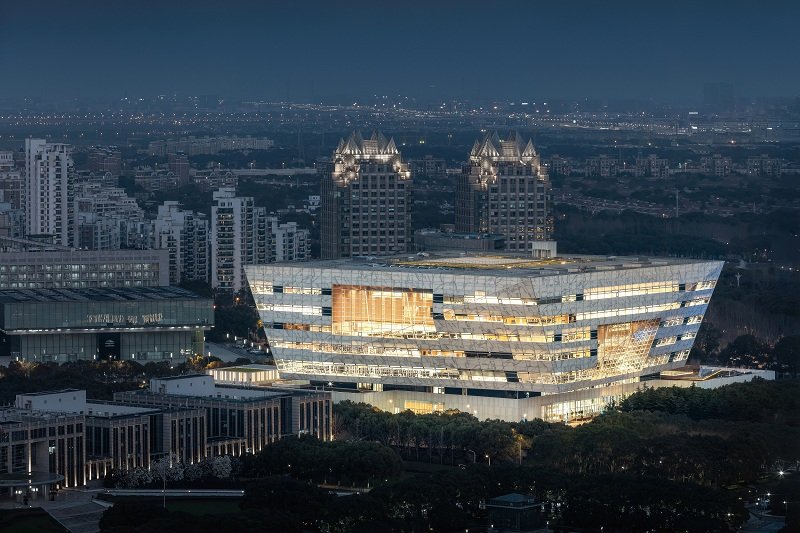
Shanghai Library’s main facilities are associated with the cultural landscape of Shanghai. The library’s architecture reflects the importance of the institution as a public cultural space.
A modern library needs to accomplish several goals at once. It must provide quiet areas for reading and research, spaces for public activities, technology for accessing digital resources, storage for valuable collections, and facilities for exhibitions and educational programs.
The design of Shanghai Library reflects these requirements. Its spaces are organized to accommodate different kinds of users and activities. Readers can find areas for individual study, research, consultation, and access to library services.
The library environment also demonstrates how modern libraries have changed. Contemporary libraries are increasingly designed as cultural and learning centers rather than simply storage facilities for books.
Collections of Shanghai Library
One of the greatest strengths of Shanghai Library is its extensive collection of information resources.
The library contains materials covering a wide variety of subjects. These resources support both general reading and specialized academic research.
Important categories include books, newspapers, journals, manuscripts, maps, photographs, genealogical materials, and digital resources.
Chinese Books and Literature
Chinese-language books represent a major part of the library’s collections. Readers can find works covering Chinese literature, history, philosophy, politics, economics, science, technology, education, art, and social sciences.
Literary collections are especially valuable for researchers studying Chinese writers and the development of Chinese literature.
Newspapers and Periodicals
Newspapers and periodicals are important historical sources. They allow researchers to study events and public discussions from particular periods.
Historical newspapers can provide information about politics, business, social life, education, entertainment, international relations, and everyday life.
For researchers studying Shanghai, newspapers are particularly useful because they document the city’s transformation over many decades.
Rare Books
The library also preserves rare and valuable books. Rare books are important not only because they may be old, but also because they can provide evidence about publishing, language, scholarship, and intellectual life.
Preserving these materials requires specialized storage and conservation methods. Libraries must protect rare books from humidity, excessive light, temperature changes, insects, and physical damage.
Manuscripts and Historical Documents
Manuscripts can provide unique information that is not available in ordinary published books. Personal letters, handwritten documents, literary manuscripts, diaries, and other materials can help researchers understand historical individuals and institutions.
Shanghai Library’s historical resources therefore have value far beyond the city itself.
Genealogy Collection
One particularly important area associated with Shanghai Library is genealogy.
Genealogical records can document family histories, relationships, ancestral locations, migrations, and social connections. Such records are valuable to historians as well as individuals researching their family backgrounds.
China has a long tradition of compiling genealogical records. These documents can help researchers understand population movement, local communities, family structures, and historical relationships.
The preservation of genealogical materials is therefore an important cultural responsibility.
Shanghai History Collection
Shanghai Library has a strong connection with the history of Shanghai.
Researchers interested in the city can use library resources to explore many aspects of its development, including architecture, transportation, commerce, education, industry, immigration, publishing, literature, and everyday life.
Historical maps and photographs can be especially useful. A map from an earlier period can show how neighborhoods and roads developed, while historical photographs can reveal how buildings and public spaces changed.
Together, these materials create a detailed picture of Shanghai’s past.
Digital Transformation
Like major libraries around the world, Shanghai Library has embraced digital technology.
Digital transformation has changed how people discover and use information. Instead of requiring every researcher to visit the library physically, digital systems can provide access to catalog information, databases, digitized materials, and other resources.
Digitization also has an important preservation function. Fragile historical documents can be scanned and stored digitally, allowing researchers to study them while reducing unnecessary handling of original materials.
Digital technology can also make historical resources accessible to a much wider audience.
Research and Education
Shanghai Library plays an important role in research and education.
Students can use library resources for school and university projects. Researchers can consult specialized collections for academic work. Historians can study primary sources, while writers and journalists can use library materials for background research.
The institution can also support lifelong learning. People do not need to be university students or professional researchers to benefit from a major public library.
A library can help people learn new subjects, improve their knowledge, explore hobbies, and develop research skills.
Cultural Events and Exhibitions
Modern libraries increasingly serve as public cultural centers, and Shanghai Library is part of this broader trend.
Libraries can organize exhibitions, lectures, discussions, educational programs, literary events, and other activities.
Exhibitions are particularly useful because they can introduce historical documents and cultural materials to people who might not otherwise encounter them.
A carefully designed exhibition can bring together books, photographs, manuscripts, maps, and explanations to tell a story about a person, period, city, or cultural movement.
Such programs make the library a place for active cultural participation rather than passive reading alone.
Shanghai Library and International Research
Shanghai has long had international connections, and its library resources can be valuable for researchers studying the relationship between China and the wider world.
Researchers may use historical newspapers, foreign-language materials, maps, books, and other documents to investigate international trade, diplomacy, migration, cultural exchange, and urban development.
The library’s collections can therefore support research that goes beyond Chinese national history.
Shanghai’s position as a global city makes its historical resources particularly interesting to scholars studying international urban development.
Importance for Students
Students can benefit from Shanghai Library in many ways.
A good library provides students with reliable information and encourages independent learning. Instead of depending entirely on short online summaries, students can consult books, academic resources, newspapers, reference materials, and original documents.
Library research can also teach important skills such as:
- Finding reliable information
- Comparing sources
- Taking research notes
- Understanding historical evidence
- Evaluating different viewpoints
- Citing sources
- Organizing information
These skills are useful not only in education but also in professional life.
Importance for Historians
For historians, libraries are essential because historical research depends heavily on primary and secondary sources.
Primary sources may include newspapers, manuscripts, letters, photographs, maps, and official documents. Secondary sources include books and academic studies written by historians and other researchers.
Shanghai Library’s historical collections can help researchers reconstruct events and understand changes in Chinese society.
The value of such materials increases over time because original documents can disappear or become difficult to access elsewhere.
Preservation of Cultural Heritage
One of the most important responsibilities of a major library is cultural preservation.
Books and documents are vulnerable to physical deterioration. Paper can become fragile, ink can fade, and environmental conditions can damage collections.
Libraries therefore use preservation techniques to protect valuable materials.
Digitization provides an additional layer of protection. Digital copies can help researchers access information without repeatedly handling fragile originals.
Preservation is important because cultural heritage belongs not only to the present generation. Future researchers also need access to historical evidence.
A Library in a Modern Megacity
Shanghai is a huge and rapidly developing metropolitan area. Skyscrapers, technology companies, universities, museums, transportation networks, shopping districts, and residential communities form a constantly changing urban environment.
In this setting, a major public library provides a different kind of space.
Libraries offer places where people can slow down, read, study, investigate, and think.
The importance of this role has not disappeared in the digital age. In some ways, access to enormous quantities of online information makes libraries even more valuable because users need reliable systems for discovering and evaluating information.
Shanghai Library in the Digital Age
The idea that the internet will make libraries unnecessary has not proven to be simple.
The internet provides enormous quantities of information, but not every online source is reliable, complete, or easy to interpret. Libraries contribute organized collections, professional services, research tools, preservation, and access to specialized resources.
Shanghai Library combines traditional library functions with modern technology.
This combination allows it to remain relevant to contemporary users while preserving historical collections.
Why Shanghai Library Matters
Shanghai Library matters for several interconnected reasons.
First, it provides public access to knowledge. Second, it preserves valuable historical materials. Third, it supports education and academic research. Fourth, it contributes to cultural life in Shanghai. Fifth, its collections can help researchers understand Chinese and international history.
A great library is ultimately more than a collection of objects. It is a system for connecting people with knowledge.
Shanghai Library demonstrates how a library can serve both local communities and the wider research world.
Visiting and Using Shanghai Library
People interested in using Shanghai Library should check the institution’s current official information before planning a visit. Library access rules, opening hours, registration requirements, reading-room policies, exhibitions, and available services can change.
Visitors may be able to explore public spaces, consult collections, participate in cultural activities, or use research facilities depending on the current rules.
Researchers working with rare or special collections may need to follow additional procedures.
Planning ahead is particularly useful when researching historical materials because some collections may require advance requests or special permissions.
Conclusion
Shanghai Library is an important cultural and educational institution that reflects both the historical depth and modern development of Shanghai. Its extensive collections, historical documents, research resources, digital services, cultural activities, and educational role make it much more than a conventional public library.
Its value can be understood through several major functions: collecting knowledge, preserving cultural heritage, supporting research, encouraging education, and providing public access to information.
From rare books and historical newspapers to genealogical records and digital resources, the library preserves materials that help people understand the past. At the same time, its modern services support students, researchers, professionals, and general readers in the present.
As technology continues to change how people find and consume information, institutions such as Shanghai Library remain important. They provide organized knowledge, preserve original sources, and create spaces for learning and cultural exchange.
Shanghai Library therefore represents an important connection between the past, present, and future. Its collections help preserve the memory of Shanghai and China, while its modern services help new generations discover, study, and build upon that knowledge.
For anyone interested in libraries, Chinese history, Shanghai’s development, literature, genealogy, or cultural heritage, Shanghai Library is an institution of considerable importance. Its continuing development demonstrates how major libraries can adapt to technological and social change while maintaining their fundamental mission: preserving knowledge and making it available to people.