New York Public Library History, Architecture, Collections, Services, and Global Importance
Introduction
The New York Public Library, commonly known as the NYPL, is one of the most famous and important library systems in the world. Located in New York City, United States, the library has played a major role in education, research, culture, literature, and public life for more than a century. It is not simply a place where books are stored. It is a major cultural institution that provides access to millions of books, manuscripts, photographs, maps, historical documents, digital resources, exhibitions, educational programs, and community services.
For generations, the New York Public Library has helped students, teachers, researchers, writers, historians, journalists, artists, and ordinary members of the public discover information and develop knowledge. Its collections cover subjects ranging from literature and history to science, art, music, politics, geography, philosophy, and many other areas of human knowledge.
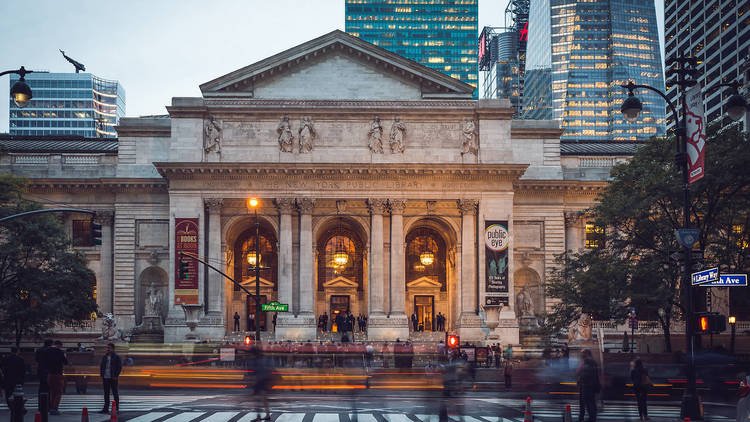
The New York Public Library is also famous for its beautiful architecture. The Stephen A. Schwarzman Building on Fifth Avenue and 42nd Street is one of New York City’s most recognizable landmarks. Its grand entrance, stone lions, impressive reading rooms, historic interiors, and enormous research collections make it a destination for both researchers and visitors.
The NYPL is also unusual because it combines the functions of a major research library with a large public library system. Through its branches across Manhattan, the Bronx, and Staten Island, the institution provides library services to millions of New Yorkers.
This article explores the history, development, architecture, collections, services, educational role, digital resources, cultural importance, and continuing future of the New York Public Library.
What Is the New York Public Library?
The New York Public Library is a major public library system and research institution serving New York City. It was created in the late nineteenth century through the consolidation of important library collections and institutions.
The library’s research system is particularly famous for its extensive historical and scholarly collections. At the same time, the NYPL operates a network of neighborhood branches where residents can borrow books, access computers and internet services, attend programs, study, and participate in educational activities.
The institution therefore serves two closely connected purposes.
First, it provides public library services to communities throughout New York City.
Second, it preserves and provides access to significant research collections used by scholars and researchers from around the world.
This combination has helped make the New York Public Library an important part of New York City’s educational and cultural infrastructure.
The Origins of the Library
The history of the New York Public Library is connected to several earlier libraries and collections.
During the nineteenth century, New York City was experiencing rapid population growth. The city was becoming an important center of commerce, immigration, publishing, education, and culture. As the population increased, the demand for educational resources and public access to books also increased.
Several institutions attempted to meet these needs.
Two particularly important organizations were the Astor Library and the Lenox Library. Another major collection came from the Tilden Trust.
The Astor Library was established through the financial support of businessman John Jacob Astor. It opened in the mid-nineteenth century and became an important reference library.
The Lenox Library was established through the collection and financial support of James Lenox. It became particularly known for rare books, manuscripts, Americana, and important literary materials.
Samuel J. Tilden, a former governor of New York, also left a large portion of his estate for the creation of a free public library in New York City.
Eventually, these resources were brought together into a new institution.
The Creation of the New York Public Library
The New York Public Library was formally established in the 1890s through the consolidation of the Astor Library, Lenox Library, and Tilden Trust.
This was an important development in the history of American libraries because it combined major collections and financial resources into a single institution.
The newly formed library was intended to serve the public while also maintaining major research collections.
Over time, the institution expanded its buildings, collections, services, and branch network.
The establishment of the NYPL reflected a broader nineteenth-century idea: knowledge and education should be accessible to the public.
Libraries were increasingly seen not merely as private collections for wealthy individuals or academic institutions but as essential public resources.
The New York Public Library became one of the most significant examples of this idea.
The Stephen A. Schwarzman Building
One of the most recognizable parts of the New York Public Library is the Stephen A. Schwarzman Building at Fifth Avenue and 42nd Street.
This building is often what people mean when they picture the New York Public Library.
The building was designed in the Beaux-Arts architectural tradition, a style associated with grand public buildings, symmetry, classical details, monumental entrances, and elaborate decoration.
Construction began in the early twentieth century, and the building opened to the public in 1911.
Its scale was remarkable for its time.
The building was designed to accommodate enormous collections and large numbers of readers. It included reading rooms, offices, storage areas, research spaces, and specialized facilities.
Today, the building remains one of New York City’s most important architectural and cultural landmarks.
The Famous Stone Lions
Two stone lions stand outside the main entrance of the Stephen A. Schwarzman Building.
They are among the most recognizable symbols of the New York Public Library.
The lions were sculpted as part of the building’s original design and became closely associated with the institution.
They are commonly known as Patience and Fortitude.
The names represent qualities traditionally associated with success in learning and public life.
The lions have become an iconic part of New York City. Visitors frequently photograph them, and they appear in books, documentaries, films, television programs, and images of New York.
The lions also demonstrate how the library has become more than an institution for books. Its physical presence has become part of the identity of the city itself.
Architecture of the Main Building
The Stephen A. Schwarzman Building contains numerous architectural details that reflect the importance given to libraries during the early twentieth century.
The exterior uses classical forms and monumental proportions.
Inside, visitors encounter large halls, decorative ceilings, carved stonework, murals, paintings, wood details, and grand reading spaces.
The architecture communicates an important message: knowledge and education deserve a significant public space.
This was particularly important at a time when public institutions were often designed to demonstrate civic pride.
The building’s architecture has helped preserve this idea for more than a century.
The Rose Main Reading Room
One of the most famous spaces in the New York Public Library is the Rose Main Reading Room.
The room is enormous and has become an international symbol of libraries and scholarship.
Long tables provide space for readers and researchers. Large windows bring natural light into the room, while elaborate chandeliers and decorative ceiling elements create a distinctive atmosphere.
The reading room is particularly famous for its impressive scale.
For many visitors, entering the room creates the feeling of being inside a great center of knowledge.
The room has also appeared in popular culture and has been photographed by millions of visitors.
Although it is visually impressive, its primary purpose remains scholarly work and reading.
The Importance of Reading Rooms
Reading rooms have traditionally been central to research libraries.
Before digital databases became common, researchers depended heavily on physical books, journals, newspapers, manuscripts, maps, and other materials.
A major reading room provided researchers with a quiet environment in which they could study these resources.
The NYPL’s reading rooms continue this tradition.
Researchers can consult specialized collections and use library resources that may not be available elsewhere.
The atmosphere of a traditional research library can also encourage concentration and extended study.
The Research Libraries
The New York Public Library’s research system contains collections covering many areas of knowledge.
Researchers can explore literature, history, art, performing arts, social sciences, genealogy, maps, manuscripts, and many other subjects.
The library’s research collections include both published materials and unique primary sources.
Primary sources can include personal letters, diaries, photographs, manuscripts, historical records, drawings, maps, and other original documents.
These resources are extremely valuable for historians and scholars because they provide evidence about the past.
Major Collections
The NYPL holds millions of items in its collections.
These materials represent many centuries and numerous cultures.
Among the important categories are:
- Books
- Manuscripts
- Maps
- Newspapers
- Magazines
- Photographs
- Prints
- Drawings
- Posters
- Music materials
- Historical documents
- Rare books
- Personal papers
- Archival collections
- Digital materials
The diversity of these collections is one of the institution’s greatest strengths.
Rare Books and Manuscripts
Rare books and manuscripts are particularly important parts of the NYPL’s research collections.
Rare materials may be valuable because of their age, historical significance, scarcity, association with important individuals, or artistic qualities.
Manuscripts can provide direct evidence of how writers, artists, politicians, scientists, and other individuals developed their ideas.
Researchers can use these materials to study literary history, social history, intellectual history, and cultural development.
Literary Collections
The New York Public Library has especially important collections related to literature.
New York has long been a major center of American publishing and literary life, making the library’s literary collections particularly significant.
Researchers can find materials connected to famous writers, literary movements, publishing history, and the development of American literature.
The library’s collections can help scholars understand not only finished books but also the creative processes behind them.
Drafts, correspondence, notebooks, and other documents can reveal how literary works developed over time.
The Schomburg Center for Research in Black Culture
One of the most important research centers associated with the New York Public Library is the Schomburg Center for Research in Black Culture.
Located in Harlem, the Schomburg Center is a major research institution devoted to documenting and preserving the history and culture of people of African descent.
Its collections cover subjects such as African American history, African history, the African diaspora, literature, politics, art, music, and social movements.
The center was named after Arturo Alfonso Schomburg, a Puerto Rican-born collector, historian, and intellectual of African and European heritage.
Schomburg developed an important collection of materials related to Black history and culture.
His collection became part of the New York Public Library and eventually contributed to the creation of the research center that bears his name.
The Schomburg Center is internationally important because it preserves materials that might otherwise have been lost or scattered.
The Library for the Performing Arts
Another major research facility is the New York Public Library for the Performing Arts.
Located at Lincoln Center, it contains collections related to theater, dance, music, opera, film, and other performing arts.
Researchers can explore scripts, photographs, recordings, posters, costumes, musical scores, production materials, and archival documents.
The collection provides valuable evidence about the history of performance.
Students and scholars studying Broadway, American theater, classical music, jazz, dance, opera, and other performing arts can benefit from these resources.
Music Collections
The NYPL also has extensive music-related materials.
Music collections can include printed scores, manuscripts, recordings, correspondence, photographs, and other documents.
These resources support research into composers, performers, musical traditions, and the history of musical performance.
The library’s music resources are important not only to historians but also to musicians, educators, and students.
Maps and Geographic Collections
Maps are another important part of the library’s historical collections.
Historical maps can reveal how cities, countries, borders, transportation systems, and landscapes changed over time.
The NYPL has significant map collections that support research in geography, history, urban development, exploration, and cartography.
Maps can also be valuable for studying New York City itself.
By comparing historical maps with modern geographic information, researchers can understand how neighborhoods, roads, buildings, parks, and transportation networks developed.
Photographic Collections
Photography provides another major source of historical evidence.
The library’s photographic collections contain images documenting people, places, events, buildings, cultures, and everyday life.
Historical photographs can help researchers understand how communities changed over generations.
They can also provide visual evidence that complements written records.
Digital Collections
The New York Public Library has invested heavily in digitization.
Digitization allows physical materials to be converted into digital formats that can be viewed online.
This is important because researchers do not always have the ability to travel to New York City.
Digital collections can make rare and historical materials available to people around the world.
Digitization also provides additional protection for fragile originals because researchers may be able to study digital copies without repeatedly handling the physical objects.
The NYPL Digital Collections
The library’s digital collections contain large numbers of digitized materials.
Users can explore photographs, maps, manuscripts, prints, illustrations, documents, and other resources.
Digital access has transformed how people interact with research libraries.
A student in another country can potentially examine historical material held in New York without physically visiting the library.
This global accessibility has increased the educational influence of the NYPL.
Public Library Branches
Although the main research buildings receive significant attention, the New York Public Library is much larger than a single building.
The NYPL operates numerous neighborhood branches across New York City.
These branches serve local communities by providing books, educational resources, computers, internet access, study spaces, programs, and other services.
For many New Yorkers, their local branch is their most direct connection to the library system.
Libraries and Communities
Neighborhood libraries can play an important role in community life.
A branch may serve children learning to read, students preparing for examinations, adults searching for employment information, immigrants learning English, older adults exploring hobbies, and residents seeking internet access.
This broad range of users demonstrates why public libraries remain important even in the digital age.
Access to information is not equally distributed among all communities.
Public libraries can help reduce barriers by providing resources without requiring users to purchase expensive books, databases, or technology.
Children’s Programs
Children are an important part of the NYPL’s public mission.
Libraries offer children’s books, reading programs, educational events, storytelling activities, homework support, and other services.
Early exposure to libraries can help children develop reading habits and research skills.
Libraries also provide safe and educational environments where young people can explore subjects beyond their school curriculum.
Teen Services
Teenagers can also use NYPL resources for education, creativity, and personal development.
Programs may include homework assistance, workshops, technology activities, reading programs, career information, and cultural events.
Teen library services are especially valuable because young people are developing independent research and information skills.
Services for Students
Students can use the New York Public Library for many types of academic work.
They can borrow books, consult reference materials, use computers, access online resources, study in quiet spaces, and attend educational programs.
Research libraries provide access to materials that may not be available through ordinary school libraries.
University students and independent researchers can also use the institution’s specialized collections.
Services for Researchers
Researchers generally require different services from casual visitors.
They may need access to rare materials, archival collections, specialized databases, manuscripts, historical newspapers, or restricted collections.
The NYPL provides research services designed to help scholars locate and use these resources.
Research librarians can also help users understand how to navigate complex collections.
Librarians and Their Role
Librarians are an essential part of the New York Public Library.
Modern librarians do much more than organize books.
They help users find reliable information, navigate databases, understand research methods, locate historical documents, and develop information-literacy skills.
In a world filled with enormous amounts of online information, the ability to evaluate sources has become increasingly important.
Libraries can help people distinguish between reliable evidence and unsupported claims.
Information Literacy
Information literacy means knowing how to find, evaluate, understand, and use information effectively.
This skill is increasingly important because the internet provides access to both high-quality and low-quality information.
A library can teach users how to search catalogs, evaluate sources, understand citations, and conduct research.
The NYPL therefore contributes not only by providing information but also by helping people learn how to use information responsibly.
The Library and New York City
The history of the New York Public Library is closely connected to the history of New York City.
As the city grew, so did the library.
New York became a center of immigration, business, publishing, arts, politics, education, and international exchange.
The library developed alongside these changes.
Its collections preserve evidence of the city’s transformation.
Researchers can study the development of neighborhoods, industries, communities, cultural movements, and public institutions through library materials.
The Library and Immigration History
New York City has historically been home to people from many parts of the world.
The library’s collections contain materials that can help researchers study immigration and diaspora communities.
Documents, newspapers, photographs, books, maps, and personal papers can reveal how immigrant communities established themselves and contributed to the city.
Genealogists can also use library resources to investigate family histories.
Genealogy and Family History
Genealogy is another important area of library research.
People often visit libraries to investigate their family backgrounds.
Historical newspapers, city directories, immigration records, maps, manuscripts, and other sources can provide clues about ancestors.
Genealogical research can be complicated because records may contain inconsistent spellings, incomplete information, or difficult historical terminology.
Libraries provide tools and guidance that can help researchers organize these discoveries.
The Library’s Role in Education
Education has always been central to the public library mission.
Unlike a school or university, a public library can serve people throughout their entire lives.
A child may use the library for picture books.
A teenager may use it for school research.
A university student may consult scholarly collections.
An adult may use it to learn a new skill.
A retired person may research family history.
This lifelong educational role is one reason public libraries remain valuable.
Libraries in the Digital Age
The rise of the internet changed the way people access information.
Some people initially predicted that physical libraries would become unnecessary.
However, major libraries have adapted.
The NYPL now combines traditional collections with digital resources.
Users can access online catalogs, digitized collections, electronic materials, databases, virtual programs, and digital research tools.
At the same time, physical books, manuscripts, archives, and reading rooms remain important.
The modern library therefore exists in both physical and digital environments.
Preservation of Historical Materials
One of the library’s most important responsibilities is preservation.
Historical materials can deteriorate over time because of light, humidity, temperature, physical handling, chemical processes, and other factors.
Libraries use specialized preservation techniques to protect important collections.
Preservation may involve careful storage, conservation treatment, digitization, and controlled access.
Without preservation efforts, many historical documents could eventually become damaged or unusable.
Why Preservation Matters
Historical documents provide evidence about the past.
A letter written by a famous author, an old map of New York, a historical photograph, or an original manuscript may contain information that cannot be recreated once lost.
Preserving such materials therefore benefits future generations.
Libraries act as custodians of collective memory.
The NYPL’s preservation work contributes to the preservation of American and global cultural history.
Exhibitions
The New York Public Library regularly presents exhibitions based on its collections.
Exhibitions can focus on literature, history, art, politics, music, popular culture, science, or other topics.
These exhibitions provide a way for members of the public to interact with materials that might otherwise be seen mainly by researchers.
Exhibitions also demonstrate how historical documents can be interpreted and presented in accessible ways.
Public Programs
The NYPL organizes many public programs.
These may include lectures, conversations, author events, workshops, performances, educational activities, and cultural discussions.
Such programs transform the library from a quiet research environment into an active cultural institution.
People can encounter new ideas, hear from writers and scholars, and participate in educational events.
Authors and the Library
The New York Public Library has a particularly strong relationship with writers.
New York City has been home to generations of authors, journalists, poets, playwrights, and publishers.
The library provides writers with research materials and quiet spaces for study.
Its literary collections also preserve the work and correspondence of many important authors.
For writers researching historical settings, characters, events, or cultural movements, the library can be an invaluable resource.
The Library as a Cultural Institution
Modern libraries are increasingly understood as cultural institutions.
They preserve heritage, support education, organize exhibitions, host public programs, and encourage intellectual exchange.
The New York Public Library demonstrates this expanded role.
It is simultaneously a library, research center, archive, educational institution, exhibition space, and public cultural organization.
The Library and Technology
Technology has changed nearly every aspect of library operations.
Digital catalogs make it easier to locate materials.
Electronic databases provide access to scholarly information.
Digitization expands public access.
Computers and internet services support research and communication.
Data systems help librarians organize enormous collections.
At the same time, technology creates new challenges.
Digital information must also be preserved, organized, authenticated, and made accessible.
Artificial Intelligence and Libraries
As artificial intelligence becomes increasingly important, libraries face new opportunities and challenges.
AI can assist with information discovery, text analysis, digitization workflows, transcription, and research.
However, libraries must also consider questions about accuracy, copyright, privacy, bias, and the reliability of automatically generated information.
The fundamental mission remains the same: helping people access trustworthy knowledge.
Copyright and Access
Libraries must balance public access with copyright law.
Many modern publications remain protected by copyright.
Historical materials may also have complicated rights issues.
Digitization therefore requires careful consideration of intellectual property.
The NYPL works within legal and institutional frameworks to make as much material available as possible while respecting rights and restrictions.
The Importance of Free Public Access
The idea of free access is central to public libraries.
People should be able to explore information without needing significant financial resources.
A public library provides a shared educational infrastructure.
This principle is particularly important in large cities where economic circumstances vary greatly between communities.
The Library During Difficult Times
Libraries have historically continued serving communities during periods of social and economic difficulty.
People may rely on libraries for information, internet access, educational resources, and community support during challenging circumstances.
The NYPL’s long history reflects the ability of public institutions to adapt to changing needs.
The Library During the COVID-19 Era
The COVID-19 pandemic created major challenges for libraries worldwide.
Physical access to buildings was affected by public-health restrictions.
Libraries responded by expanding or emphasizing digital services, online programming, electronic resources, and other remote forms of access.
The experience demonstrated the importance of digital infrastructure.
It also showed why physical library spaces remain valuable.
The Future of the New York Public Library
The future of the NYPL will likely involve a combination of traditional and digital services.
Physical books will continue to matter.
Rare collections will require preservation.
Research reading rooms will remain important.
At the same time, digital collections will continue expanding.
Online education and virtual programs may reach audiences far beyond New York City.
Technology will increasingly influence how people discover and use information.
Why the NYPL Matters Globally
Although the library is based in New York City, its influence extends far beyond the city.
Researchers from around the world use its collections.
Digital materials can be accessed internationally.
Its exhibitions and educational programs reach broad audiences.
Its architecture has become internationally recognizable.
Its collections preserve materials connected to global history and culture.
For these reasons, the NYPL is an institution of international significance.
Visiting the New York Public Library
Visitors to New York City often include the main library building in their sightseeing plans.
The Stephen A. Schwarzman Building is located in Midtown Manhattan near Bryant Park.
Visitors can appreciate the exterior architecture, stone lions, interior spaces, exhibitions, and public areas.
However, research areas may have specific rules and access requirements.
Researchers planning serious academic work should check current library policies before visiting.
Bryant Park and the Library
The main library building sits beside Bryant Park.
The relationship between the library and the park creates one of Manhattan’s most distinctive urban spaces.
Visitors can move between the green public space of the park and the grand cultural environment of the library.
This combination contributes to the area’s unique character.
The Library in Popular Culture
The New York Public Library has appeared in movies, television programs, photographs, books, advertisements, and other forms of popular culture.
Its architecture makes it visually attractive for filmmakers and photographers.
The Rose Main Reading Room is especially recognizable.
Popular culture has helped introduce the library to people who may never have visited New York.
Symbolism of the Library
The NYPL symbolizes several important ideas.
It represents knowledge.
It represents education.
It represents public access to information.
It represents preservation of history.
It represents intellectual curiosity.
The stone lions, grand architecture, and reading rooms reinforce these associations.
How the Library Supports Researchers
Researchers may use the NYPL for many different purposes.
A historian may study manuscripts.
A literary scholar may examine an author’s papers.
A genealogist may investigate family records.
A music researcher may examine scores.
An urban historian may study maps and photographs.
A journalist may research historical events.
An artist may explore visual collections.
The diversity of users demonstrates the breadth of the library’s mission.
The Value of Primary Sources
Primary sources are among the most valuable materials held by research libraries.
A primary source is generally an original document or object connected directly to a historical event, person, or period.
Examples include diaries, letters, photographs, manuscripts, maps, recordings, and original publications.
Primary sources allow researchers to examine evidence directly rather than relying only on later interpretations.
The NYPL’s collections provide access to many such materials.
Libraries and Historical Memory
Libraries play a major role in preserving collective memory.
Without archives and libraries, historical evidence can disappear.
Books may be destroyed.
Letters can be discarded.
Photographs can deteriorate.
Records can be lost.
Libraries provide systems for preserving these materials.
The New York Public Library is therefore an important guardian of historical memory.
The Relationship Between Books and Digital Information
Physical books and digital information should not necessarily be viewed as competing systems.
Each has advantages.
Physical books provide a tangible reading experience and can preserve information for centuries when properly maintained.
Digital resources provide speed, searchability, remote access, and opportunities for large-scale analysis.
The modern NYPL combines both approaches.
Research in the Twenty-First Century
Modern researchers increasingly use both physical and digital sources.
A historian might discover a digitized photograph online, identify a collection, and then visit the library to examine related original documents.
A student might use the library catalog to locate a book and then access related digital resources.
This combination demonstrates how research libraries are evolving.
The Importance of Community
A successful public library is not simply a warehouse of information.
It is a community institution.
People gather there to read, learn, study, attend events, use technology, and exchange ideas.
The NYPL’s branch network gives this community role a particularly large scale.
Public Libraries and Equality of Access
Libraries can help create greater equality in access to knowledge.
Not every person can afford a large private library, expensive research databases, high-speed internet, or a quiet study environment.
Public libraries can provide many of these resources free of charge or at very low cost.
This is one of the most important social functions of public libraries.
The NYPL and Lifelong Learning
Learning does not end when formal schooling ends.
Adults continue learning throughout their lives.
They may study languages, history, technology, literature, business, art, science, or practical skills.
Libraries support this lifelong learning process.
The NYPL serves users at many different stages of life.
Why Students Should Use Libraries
Students can benefit from libraries in several ways.
Libraries can help students:
- Find reliable sources
- Develop research skills
- Discover books beyond school assignments
- Study in quiet environments
- Access computers and digital resources
- Learn how to evaluate information
- Explore historical primary sources
- Develop independent learning habits
These skills remain valuable long after a student graduates.
Why Researchers Should Use the NYPL
Researchers can benefit from the NYPL because of the depth and variety of its collections.
The institution’s archival materials can provide evidence unavailable through ordinary internet searches.
Its specialized research centers provide expertise in particular subjects.
Its librarians can help researchers navigate complex collections.
Its digital resources also allow research to begin before a physical visit.
The Library’s Enduring Legacy
The New York Public Library has survived enormous changes in technology, society, education, and urban life.
It began during a period when printed books were the dominant medium of recorded knowledge.
It expanded during the age of mass publishing.
It developed major research collections during the twentieth century.
It entered the digital age by creating online resources and digitizing historical materials.
Its continuing evolution demonstrates the adaptability of libraries.
Conclusion
The New York Public Library is much more than a famous building in Manhattan. It is a major educational, research, cultural, and historical institution that has served New York City and the wider world for generations.
Its history is rooted in the creation and consolidation of important nineteenth-century library collections. Its magnificent Stephen A. Schwarzman Building represents the importance that earlier generations placed on public knowledge and education. Its famous stone lions, grand halls, and Rose Main Reading Room have become symbols recognized around the world.
At the same time, the NYPL is not simply a historic monument. It remains an active library system serving communities across New York City.
Its research libraries preserve rare books, manuscripts, photographs, maps, music, literary papers, and countless other materials. Specialized centers such as the Schomburg Center for Research in Black Culture and the Library for the Performing Arts expand the institution’s research mission into important areas of cultural history.
Its neighborhood branches provide everyday services to children, students, families, workers, researchers, and lifelong learners. Through books, technology, educational programs, public events, and digital resources, the library continues to connect people with knowledge.
The digital transformation of the library has also expanded its global reach. Digitized collections allow people in different countries to explore historical materials without traveling to New York. At the same time, the continued importance of physical books, manuscripts, archives, preservation, and reading spaces demonstrates that traditional libraries remain relevant.
Perhaps the greatest significance of the New York Public Library is the idea it represents: knowledge should be preserved, shared, and made accessible to the public.
For more than a century, the NYPL has helped people read, research, learn, create, and understand the world around them. Its buildings preserve history, its collections support scholarship, and its public services support communities.
As technology continues to change how people find and use information, the New York Public Library will continue to evolve. Its future may look different from its past, but its central mission—to connect people with knowledge and preserve important cultural resources—remains deeply relevant.
The New York Public Library therefore stands as one of the world’s most significant examples of what a library can become: a place where history is preserved, education is supported, research is encouraged, culture is shared, and people from many backgrounds can encounter the vast record of human knowledge.