Royal Danish Library: A Complete History, Collections, Architecture, and Cultural Guide
The Royal Danish Library, known in Danish as Det Kgl. Bibliotek, is one of Denmark’s most important cultural and educational institutions. Located primarily in Copenhagen, the library serves as Denmark’s national library and plays a major role in preserving the country’s written, printed, and cultural heritage. It is also closely connected with higher education and research, making it an important resource for students, scholars, historians, writers, and the general public.
The Royal Danish Library is much more than a traditional library filled with books. It is a national memory institution, a research center, a cultural venue, a preservation facility, and an increasingly digital organization. Its collections cover centuries of Danish history as well as materials from many other parts of the world. Books, manuscripts, newspapers, maps, photographs, music, historical documents, digital publications, and other cultural materials form part of its enormous heritage collections.
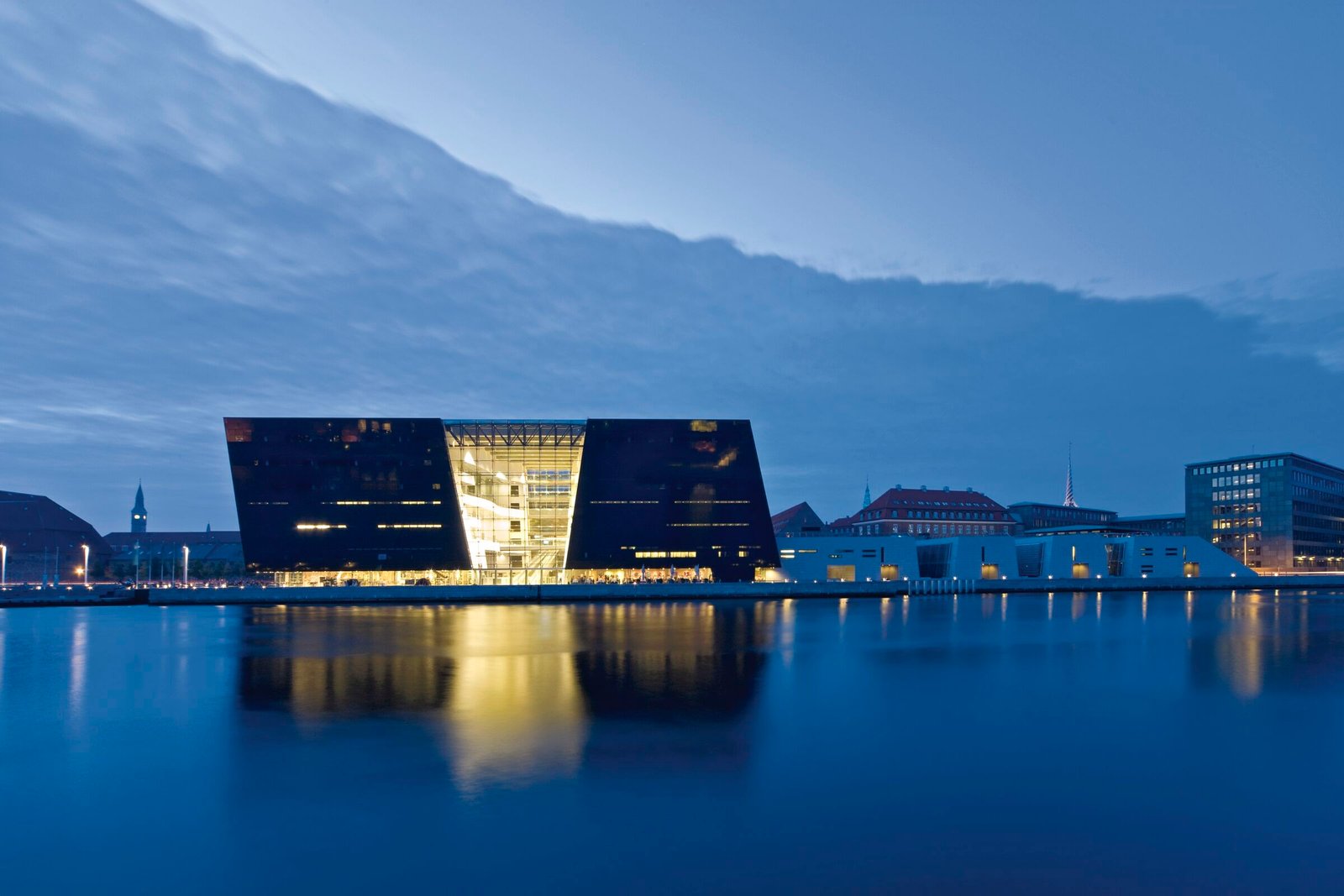
One of the most recognizable parts of the library is the Black Diamond, a striking modern extension on Copenhagen’s waterfront. Its dark glass exterior, geometric form, and location beside the harbor have made it one of the city’s best-known modern architectural landmarks. Inside, visitors can find reading rooms, exhibition spaces, cultural facilities, study areas, and views of the waterfront.
The story of the Royal Danish Library is also closely connected with the development of Denmark itself. From royal collections and early printing to modern digital information, the institution has evolved alongside society. Its history demonstrates how libraries can change while maintaining their fundamental responsibility: collecting, protecting, organizing, and providing access to knowledge.
1. Introduction to the Royal Danish Library
The Royal Danish Library is Denmark’s national library. Its responsibilities include collecting and preserving Danish publications and important cultural materials while supporting research and education.
The library is particularly important because Denmark has a long tradition of publishing, scholarship, literature, science, music, and cultural production. A national library provides a permanent place where important materials can survive for future generations.
Unlike an ordinary public library, a national library has a broader preservation mission. A public library may concentrate mainly on providing books and other resources for everyday readers, while a national library also has a responsibility to preserve the intellectual heritage of an entire country.
The Royal Danish Library combines several roles. It functions as:
- Denmark’s national library
- A major research library
- A university library
- A preservation institution
- A center for Danish cultural heritage
- A digital information provider
- A venue for exhibitions and cultural events
- A home for historic collections and archives
This combination makes the institution particularly significant within Denmark’s cultural landscape.
2. Where Is the Royal Danish Library Located?
The Royal Danish Library is associated strongly with the city of Copenhagen, Denmark’s capital. Its most famous modern building, the Black Diamond, stands along the Copenhagen waterfront.
The waterfront location is significant because Copenhagen has historically developed around its relationship with the sea. The library’s architecture therefore creates an interesting connection between Denmark’s historic capital and its modern cultural identity.
The library also operates through other facilities and locations connected with its national and university functions. These locations support different collections, research activities, preservation responsibilities, and educational services.
For visitors, the Black Diamond is particularly memorable. It combines library functions with architecture, culture, exhibitions, lectures, concerts, and public spaces.
3. The Historical Origins of the Library
The origins of the Royal Danish Library can be traced back to the royal book collections of Denmark.
During the early modern period, European monarchs often maintained private libraries containing religious works, historical texts, scientific publications, literature, maps, and other materials. Royal libraries could become important centers of knowledge because rulers and scholars collected books from different countries.
Denmark was part of this broader European intellectual environment. Over time, royal collections grew through purchases, donations, acquisitions, and the incorporation of other collections.
The establishment of a dedicated royal library represented a major step in organizing and preserving these materials.
The library eventually developed into an institution serving purposes far beyond the private interests of royalty. Its collections became part of Denmark’s national cultural heritage.
4. The Library and the Danish Enlightenment
The eighteenth century was an important period in European intellectual history. The Enlightenment encouraged greater interest in reason, science, philosophy, education, literature, and the circulation of ideas.
Libraries played an important role during this period because printed materials allowed knowledge to travel across borders.
Denmark participated in these intellectual developments. Scholars, writers, scientists, theologians, and government officials relied increasingly on books, journals, manuscripts, and other sources.
As the royal library expanded, its significance as a research resource increased. Materials collected during earlier centuries became valuable sources for later historians and researchers.
This illustrates an important characteristic of national libraries: materials originally collected for one purpose can become extremely valuable for completely different purposes centuries later.
5. The Development of a National Library
The transformation from royal library to national cultural institution happened gradually.
As Denmark developed modern educational and governmental systems, the need to preserve national publications became increasingly important. Printed works could disappear quickly if they were not systematically collected.
National libraries therefore became responsible for acquiring publications produced within their countries.
In Denmark, the Royal Danish Library developed an important role in collecting Danish literature, newspapers, books, scholarly publications, music, maps, and other forms of published material.
This responsibility helped create an extensive record of Danish intellectual and cultural life.
6. The Importance of Legal Deposit
One of the most important mechanisms supporting national libraries is legal deposit.
Legal deposit means that publishers or producers of certain types of publications are required to provide copies to a designated national institution. The exact rules can change over time and depend on national legislation.
The purpose is preservation.
Without systematic collection, many publications could disappear. A book may go out of print, a newspaper may stop publishing, or a small publication may never be reprinted. By collecting publications when they are produced, a national library can preserve them for future researchers.
The Royal Danish Library has played a major role in Denmark’s legal-deposit tradition.
This means that the library is not simply choosing a few famous books. Its national collection can include a broad representation of Danish publishing.
7. The Royal Danish Library and University Research
The Royal Danish Library also has an important relationship with higher education.
Libraries are essential to universities because students and researchers require access to scholarly literature, primary sources, databases, archives, historical documents, and other research materials.
The Royal Danish Library supports academic work across many disciplines.
Researchers may use the institution for subjects including:
- History
- Literature
- Languages
- Philosophy
- Religion
- Art history
- Music
- Political history
- Social sciences
- Science
- Medicine
- Cultural studies
- Danish studies
- European studies
The library’s historic collections are especially valuable for research that requires primary sources.
8. The Black Diamond
The Black Diamond is perhaps the most recognizable physical symbol of the Royal Danish Library.
Opened in the late twentieth century, the building dramatically expanded the library’s facilities and created a modern architectural landmark on Copenhagen’s waterfront.
Its nickname comes from its dark, reflective exterior and angular geometric shape.
The building is made largely of dark glass and stone. Depending on the light and weather, its exterior can reflect the sky, harbor, and surrounding city.
The architecture represents a contrast between old and new.
The Royal Danish Library has centuries of history, while the Black Diamond expresses a modern approach to knowledge, culture, architecture, and public space.
9. Architecture and Design
Architecture plays an important role in how visitors experience a library.
Traditional libraries often emphasize quiet interiors, rows of shelves, reading desks, and historical architectural details. The Black Diamond adds another dimension by emphasizing openness, light, movement, public gathering, and the relationship between the building and the city.
The building’s waterfront position gives visitors views toward Copenhagen Harbour.
Large glass surfaces create visual connections between the interior and exterior. The result is a building that functions not only as a library but also as a cultural landmark.
Its design demonstrates that modern libraries can serve as public spaces where people study, meet, attend events, view exhibitions, and experience architecture.
10. The Atrium and Interior Spaces
One of the memorable features of the Black Diamond is its large central interior space.
The building’s interior provides an impressive sense of scale. Natural light enters through large architectural openings, creating an atmosphere different from the traditional image of a dark and enclosed library.
Reading and study areas are designed to support concentrated academic work.
At the same time, public areas allow visitors to experience the building without necessarily being researchers.
This combination of academic and public functions is one of the strengths of modern national libraries.
11. The Collections of the Royal Danish Library
The Royal Danish Library holds an exceptionally broad range of materials.
Its collections include:
- Printed books
- Manuscripts
- Newspapers
- Periodicals
- Maps
- Photographs
- Drawings
- Music
- Historical documents
- Posters
- Archives
- Digital publications
- Special collections
- Rare books
The collections are valuable not only because of their quantity but also because of their historical diversity.
A researcher studying medieval Denmark may need manuscripts and old printed works. A nineteenth-century historian may require newspapers and political publications. A twentieth-century cultural researcher may need photographs, magazines, music, posters, or recordings.
The library’s broad collection allows researchers to investigate many different aspects of society.
12. The Book Collections
Books remain one of the central components of the library’s collections.
The collection covers Danish publications as well as international works.
Historical books are particularly important because they provide evidence about the intellectual life of previous generations.
Researchers can examine what people wrote, what subjects they studied, what ideas circulated, and how language developed.
Old books can also reveal information about printing technology, typography, publishing practices, book ownership, and reading habits.
13. Manuscripts and Rare Materials
Manuscripts are among the most valuable resources held by major research libraries.
Unlike printed books, manuscripts can preserve handwritten evidence that may exist in only one or a few copies.
Manuscripts can include personal letters, diaries, literary drafts, official documents, religious writings, scientific notes, and historical records.
The Royal Danish Library’s manuscript collections provide researchers with opportunities to study Denmark’s literary and cultural history at close range.
For literary scholars, an author’s handwritten draft may reveal changes that cannot be seen in a final printed edition.
14. Danish Literature
The library is particularly important for the preservation of Danish literature.
Denmark has produced many influential writers, poets, playwrights, philosophers, and intellectuals.
National literary collections help preserve their works and provide researchers with access to editions, manuscripts, letters, and related materials.
One of Denmark’s best-known literary figures is Hans Christian Andersen, whose fairy tales became internationally famous.
Materials associated with Andersen and other Danish writers are especially valuable because they connect literature with historical context.
Studying literary manuscripts can help researchers understand not only what an author published but also how works developed.
15. Hans Christian Andersen Collections
Hans Christian Andersen is one of Denmark’s most internationally recognized writers.
His fairy tales have been translated into numerous languages and remain widely read around the world.
The preservation of Andersen-related materials is therefore important both nationally and internationally.
Manuscripts, letters, drawings, editions, and other related materials can help researchers examine his life and work.
The library’s broader literary collections place writers within the historical context in which they lived.
For scholars, primary documents can provide information that is not available in biographies or modern summaries.
16. Newspapers and Periodicals
Newspapers are extremely valuable historical sources.
A newspaper can record political developments, local events, advertisements, social debates, cultural activities, economic conditions, and everyday life.
The Royal Danish Library has extensive newspaper-related responsibilities and collections.
Historical newspapers allow researchers to examine how events were reported at the time they happened.
They can also show differences between contemporary reporting and later historical interpretations.
For genealogists, newspapers may provide information about people, businesses, organizations, and local communities.
17. Maps and Geographic Collections
Maps form another important category of national library collections.
Historical maps provide information about how people understood geographical space at different times.
A map can show changing borders, settlements, transportation routes, coastlines, land use, and political territories.
Researchers in history, geography, architecture, urban planning, and environmental studies may use historical maps to understand how Denmark and other regions changed.
Old maps can also be valuable for studying the history of cities.
18. Photographic Collections
Photography became an important method of documenting society during the nineteenth and twentieth centuries.
Photographs can preserve visual evidence of people, buildings, landscapes, events, fashion, transportation, industry, and everyday life.
The Royal Danish Library’s photographic materials contribute to the visual history of Denmark.
A photograph of a street from a century ago can provide information that a written document may not capture.
Researchers can compare historical photographs with modern images to understand urban and social change.
19. Music Collections
The library’s cultural responsibilities also extend to music.
Music collections can include printed scores, manuscripts, recordings, and other materials.
These resources support musicologists, performers, historians, composers, and researchers.
Music is an important part of cultural heritage because it reflects social conditions, artistic movements, national identity, religious traditions, and technological changes.
Preserving musical materials ensures that future generations can study Denmark’s musical history.
20. The Library as a Cultural Institution
A modern national library does not only preserve materials behind closed doors.
The Royal Danish Library also functions as a cultural institution.
It hosts exhibitions, lectures, concerts, talks, educational programs, and other events.
These activities help connect historical collections with contemporary audiences.
An exhibition can transform a collection of manuscripts or photographs into a story that ordinary visitors can understand.
This public-facing role is increasingly important for libraries around the world.
21. Exhibitions
Exhibitions provide visitors with opportunities to see selected materials from the library’s collections.
Rare books, manuscripts, photographs, maps, artwork, and other objects can be presented in carefully designed displays.
Exhibitions can focus on individual writers, historical periods, cultural movements, scientific subjects, or major events.
They also demonstrate why preservation matters.
A document stored safely in an archive may be useful to specialists, but an exhibition can help a much wider audience understand its significance.
22. Lectures and Public Events
The library’s cultural spaces can also host lectures and discussions.
These events bring together academics, writers, artists, musicians, historians, and members of the public.
Such programs help transform the library from a place where people simply read into a place where knowledge is actively discussed.
Public events are especially useful for making research accessible to non-specialists.
23. Concerts and Performing Arts
The Black Diamond has facilities that support cultural events, including musical performances.
This is an example of how modern libraries can combine traditional knowledge functions with cultural programming.
Music inside a national library may seem unusual compared with the traditional image of shelves and reading rooms, but it reflects a broader understanding of cultural heritage.
Books, manuscripts, music, visual art, performance, and public discussion can all contribute to a society’s cultural memory.
24. Digital Transformation
One of the biggest changes affecting libraries in recent decades has been digitization.
Historically, researchers had to visit a library physically to consult many materials.
Digital technology has changed this situation.
Libraries can now scan books, manuscripts, photographs, maps, newspapers, and other materials and make digital versions available through online platforms.
The Royal Danish Library has invested heavily in digital access and preservation.
Digitization does not eliminate the importance of physical collections. Instead, it provides another way to discover and study them.
25. Digitization and Research
Digital collections are particularly valuable for researchers who live far from Copenhagen.
A researcher in another country may be able to access digitized Danish materials without traveling to Denmark.
Digital search systems can also make it easier to locate information within large collections.
For example, a researcher studying a historical event may search digitized newspapers for relevant names, dates, and terms.
This can dramatically reduce the time required to locate sources.
26. Digital Preservation
Digitization creates new responsibilities.
A digital file is not automatically safe forever.
Digital materials require storage systems, backups, technical management, file-format planning, security, and long-term preservation strategies.
The Royal Danish Library therefore has to think about both physical preservation and digital preservation.
The challenge is especially significant because digital information can exist in enormous quantities.
Modern national libraries must preserve not only books and papers but also increasingly complex digital records.
27. The Internet and National Heritage
The rise of the internet has changed the definition of published material.
In earlier centuries, publication usually meant producing a physical book, newspaper, or pamphlet.
Today, important information may appear only online.
Websites, digital newspapers, electronic books, databases, and other digital publications can become part of cultural heritage.
National libraries therefore face the challenge of preserving information that may change or disappear quickly.
Web archiving and digital collection strategies are increasingly important aspects of national library work.
28. The Library for Students
Students are among the major users of research libraries.
The Royal Danish Library provides study environments where students can read, research, write, and work on academic projects.
A good academic library offers more than books.
Students may need access to:
- Research databases
- Academic journals
- Digital books
- Reference materials
- Historical sources
- Quiet study spaces
- Computers and technology
- Librarian assistance
These services can support students throughout their academic careers.
29. The Library for Researchers
Professional researchers often require specialized sources that are unavailable through ordinary commercial bookstores or general websites.
The Royal Danish Library’s special collections are particularly important for historical and humanities research.
A historian might study an original document. A literary scholar might examine a manuscript. A music researcher might consult an old score. A cultural historian might study photographs or posters.
The library provides the infrastructure that allows this research to happen.
30. Librarians and Information Specialists
Libraries depend on trained professionals.
Librarians and information specialists help organize collections, create metadata, support researchers, preserve materials, and develop digital services.
In large research libraries, professional knowledge is particularly important because collections can be extremely complex.
A researcher may know what question they want to answer but not know which collection contains the necessary evidence.
Library specialists can help identify relevant sources.
31. Preservation of Fragile Materials
Historic materials can be extremely fragile.
Paper can deteriorate because of age, humidity, temperature, light, pollution, insects, or inappropriate handling.
Ink and pigments can also fade or damage paper.
Libraries therefore use controlled environments and professional conservation techniques.
Rare materials may be stored under carefully regulated conditions.
The goal is to slow deterioration and ensure that materials remain usable for future generations.
32. Conservation Work
Conservation specialists may repair damaged books, manuscripts, maps, photographs, and other objects.
Conservation is not simply about making an object look new.
The priority is usually to preserve the original material while preventing further deterioration.
In many cases, conservators carefully document their work so future researchers know what has been repaired or changed.
This is an important part of responsible heritage preservation.
33. Security and Handling of Rare Materials
Rare collections require careful handling.
Researchers may need to follow special procedures when consulting fragile or valuable materials.
These procedures protect the collections while still allowing legitimate research access.
National libraries must balance two responsibilities:
- Providing access.
- Protecting the physical survival of the collection.
If an irreplaceable manuscript is damaged, future researchers may lose access permanently.
34. The Importance of Cataloguing
A library can own millions of items, but those materials are useful only if people can find them.
Cataloguing is therefore a fundamental library function.
Catalog records provide information about titles, authors, dates, subjects, editions, publishers, and other characteristics.
Modern catalogues also connect physical collections with digital resources.
Good cataloguing makes research more efficient.
35. The Royal Danish Library and Danish Cultural Identity
National libraries often contribute to a country’s understanding of its own cultural identity.
The Royal Danish Library preserves evidence of Denmark’s literature, history, language, science, arts, and public life.
Its collections provide a long-term record of how Danish society developed.
This does not mean that a national culture is fixed.
Culture changes constantly.
A library’s collections can demonstrate this change by preserving materials from different periods and communities.
36. A Bridge Between Past and Present
One of the most important roles of the Royal Danish Library is connecting the past with the present.
A modern student can study a book printed centuries ago.
A historian can read an old newspaper.
A researcher can examine a manuscript written by a famous author.
A visitor can see a historic map.
A digital user can access a scanned document from another part of the world.
These activities demonstrate how libraries preserve connections across time.
37. Why National Libraries Matter
National libraries matter because cultural memory is vulnerable.
Books can be destroyed.
Archives can be lost.
Websites can disappear.
Photographs can deteriorate.
Publishers can close.
Personal collections can be scattered.
A national institution provides a stable framework for preserving important materials.
The Royal Danish Library is therefore not simply a place where people borrow books. Its deeper purpose is long-term preservation and access.
38. The Library and Future Generations
A library’s work often benefits people who have not yet been born.
A document preserved today may be studied by a researcher fifty or one hundred years from now.
This long-term perspective is one of the defining features of national libraries.
Current users may not immediately know which materials future researchers will consider important.
For that reason, preservation must be broad.
Libraries need to collect not only famous works but also everyday publications and diverse forms of documentation.
39. International Importance
Although the Royal Danish Library is Denmark’s national library, its collections have international value.
Denmark has historically participated in European intellectual, commercial, political, scientific, and cultural networks.
As a result, Danish collections can contain materials relating to many other countries and regions.
International researchers may therefore use the library for topics that go beyond Danish national history.
40. Collaboration With Other Institutions
Modern libraries increasingly cooperate with universities, museums, archives, cultural organizations, and international research institutions.
Collaboration can improve preservation, digitization, metadata, research access, and public programming.
The Royal Danish Library participates in a broader international library and cultural-heritage environment.
Such cooperation is important because no single institution can preserve every form of human knowledge independently.
41. The Role of Technology
Technology has changed almost every aspect of modern library work.
Computers help manage catalogues.
Scanning systems create digital copies.
Databases provide access to scholarly literature.
Digital preservation systems protect electronic resources.
Search technologies help researchers locate materials.
At the same time, technology creates new problems.
Digital files can become obsolete.
Large amounts of data require significant storage.
Copyright can complicate online access.
Libraries must therefore constantly adapt.
42. Copyright and Access
Libraries have to balance access with intellectual property rights.
Not every digital item can automatically be made freely available online.
Copyright laws may restrict how books, newspapers, photographs, recordings, and other works can be reproduced or distributed.
Libraries therefore need policies and technical systems that respect legal requirements while maximizing access where possible.
This is especially important for modern digital collections.
43. The Library Experience
Visiting the Royal Danish Library can provide a different experience from using an ordinary public library.
The building itself is part of the experience.
Visitors may encounter modern architecture, waterfront views, exhibitions, cultural events, reading rooms, and historic collections.
The atmosphere combines scholarship with public culture.
For tourists interested in architecture and cultural institutions, the Black Diamond is an especially notable part of Copenhagen.
44. The Black Diamond as a Copenhagen Landmark
Copenhagen is known for historic buildings, canals, palaces, churches, museums, and modern architecture.
The Black Diamond adds a distinctive contemporary element to the city’s waterfront.
Its dark exterior creates a strong visual identity.
The building demonstrates how a functional institution can also become an architectural landmark.
This is an increasingly common approach to cultural architecture.
Museums, libraries, theaters, and universities can become important parts of a city’s visual identity.
45. A Symbol of Modern Knowledge
The Black Diamond can also be understood symbolically.
Traditional libraries were often associated with shelves of printed books.
Modern libraries represent something broader: access to information in many formats.
The Royal Danish Library reflects this transformation.
Inside the institution, printed books exist alongside manuscripts, photographs, music, digital resources, databases, and cultural events.
The building’s modern architecture therefore complements the library’s changing mission.
46. Educational Importance
Education depends heavily on reliable information.
Students need trustworthy sources when preparing assignments, writing research papers, and developing academic arguments.
Research libraries provide access to materials that may not be available through ordinary internet searches.
The Royal Danish Library contributes to this educational ecosystem.
Its resources can help students learn how to find primary sources, evaluate information, understand historical context, and conduct academic research.
47. Historical Research
Historians often rely on primary sources.
Primary sources are materials created during the period being studied, such as letters, newspapers, government documents, diaries, photographs, maps, and original publications.
The Royal Danish Library’s historical collections can provide access to many types of primary evidence.
This makes the institution particularly important for reconstructing Denmark’s past.
48. Literary Research
Literary researchers may use first editions, manuscripts, correspondence, notebooks, and archival materials.
Such sources can reveal how literary works were created and received.
They can also show relationships between writers, publishers, editors, critics, and readers.
National literary collections therefore preserve much more than finished books.
They preserve the history surrounding the creation and circulation of literature.
49. Genealogy and Family History
Historical library collections can also be useful to people researching family history.
Newspapers, directories, photographs, books, local publications, and other historical materials may contain information about individuals and communities.
Genealogical research often requires combining multiple sources.
A national library can provide resources that help researchers understand the historical environment in which their ancestors lived.
50. The Value of Historical Newspapers
Newspapers are particularly useful because they capture everyday life.
A historical newspaper can contain:
- Birth announcements
- Death notices
- Business advertisements
- Local events
- Political discussions
- Cultural reviews
- Sports reports
- Employment notices
- Public announcements
This makes newspapers valuable not only for political history but also for social history.
51. The Library and Public Memory
A society’s memory is not preserved through monuments alone.
Books, newspapers, letters, photographs, maps, recordings, and digital files can preserve details that monuments cannot.
The Royal Danish Library contributes to this broader public memory.
Its collections help future generations understand how earlier generations lived, communicated, studied, created art, and understood the world.
52. Challenges Facing the Royal Danish Library
Like other national libraries, the Royal Danish Library faces significant challenges.
One challenge is the enormous growth of digital information.
Another is the cost of long-term preservation.
Libraries must also respond to changing research habits.
Users increasingly expect online access, fast search systems, digitized collections, and remote services.
At the same time, physical heritage remains important.
Maintaining both physical and digital collections requires expertise and investment.
53. The Challenge of Information Overload
Modern society produces enormous amounts of information.
Every day, millions of digital documents, websites, images, and other files are created.
A national library cannot preserve everything.
It therefore needs collection strategies that identify what should be preserved under legal and institutional responsibilities.
This makes selection and digital preservation increasingly complex.
54. Libraries in the Digital Age
Some people once predicted that digital technology would make physical libraries unnecessary.
The experience of major research libraries has shown that the situation is more complicated.
Digital resources have expanded access, but physical collections remain essential.
Original manuscripts, historic books, maps, photographs, and other objects have research value that digital copies cannot always fully replace.
Libraries therefore increasingly operate as hybrid institutions.
55. The Future of the Royal Danish Library
The future of the Royal Danish Library will likely involve continued integration of physical and digital collections.
Digitization will remain important.
Online research services will continue to develop.
Digital preservation will become increasingly significant.
At the same time, historic physical collections will require continued conservation.
The library will also continue to serve as a cultural venue.
This combination of preservation, research, technology, education, and public culture is likely to remain central to its identity.
56. Why the Royal Danish Library Is Important to Denmark
The Royal Danish Library is important because it preserves evidence of Denmark’s intellectual and cultural development.
It protects materials that document literature, history, science, art, music, journalism, and everyday life.
It also supports modern education and research.
Its role therefore extends across centuries.
The institution connects Denmark’s historical heritage with contemporary knowledge systems.
57. Why Visitors Should Know About the Library
Visitors to Copenhagen often focus on castles, museums, historic streets, and famous landmarks.
The Royal Danish Library offers a different perspective.
It combines history and modern architecture.
The Black Diamond provides an impressive example of contemporary cultural design, while the library’s collections represent centuries of knowledge.
Visitors interested in books, architecture, history, culture, photography, design, or education may find the institution particularly interesting.
58. Interesting Facts About the Royal Danish Library
Here are several useful facts about the Royal Danish Library:
- It is Denmark’s national library.
- It is commonly known in Danish as Det Kgl. Bibliotek.
- It has roots in royal book collections.
- It is closely connected with research and higher education.
- The Black Diamond is its best-known modern building.
- The Black Diamond stands beside Copenhagen’s waterfront.
- The library preserves Danish publications and cultural heritage.
- Its collections include books, manuscripts, maps, photographs, newspapers, and music materials.
- Digitization is an important part of modern access and preservation.
- The institution serves both researchers and the broader public.
- It hosts cultural events and exhibitions.
- Its collections are valuable for historical and literary research.
- It contributes to long-term preservation of Danish cultural memory.
- Its modern architecture contrasts with the age of many materials preserved inside.
- It demonstrates how a national library can function as both a research institution and a cultural venue.
59. Royal Danish Library and the Meaning of Knowledge
The history of the Royal Danish Library demonstrates that knowledge has value only when it can be preserved and transmitted.
A book that disappears cannot easily serve future generations.
A manuscript that is destroyed cannot be recreated as an original.
A website that vanishes may leave no trace unless it has been archived.
Libraries provide systems for protecting these forms of knowledge.
The Royal Danish Library is therefore part of a much larger global effort to preserve human intellectual heritage.
60. Conclusion
The Royal Danish Library is one of Denmark’s most important cultural institutions. Its history reaches back to royal collections, but its modern mission extends far beyond its origins.
Today, it functions as a national library, research institution, preservation center, university resource, digital information provider, and cultural venue.
Its collections preserve centuries of Danish and international intellectual history. Books, manuscripts, newspapers, photographs, maps, music, and digital materials provide researchers with evidence of how people lived, thought, communicated, and created.
The library’s famous Black Diamond building represents another important part of its identity. Its modern architecture demonstrates that libraries can be both places of serious research and welcoming public cultural spaces.
Perhaps the most important contribution of the Royal Danish Library is its long-term commitment to preservation. The value of many materials cannot be measured only by their usefulness today. A document that seems ordinary now may become an important historical source in the future.
This is why national libraries remain important even in the digital age.
The Royal Danish Library connects the past, present, and future. It protects Denmark’s documentary heritage while providing modern researchers, students, and visitors with opportunities to explore knowledge in many forms.
Its collections show that history is not preserved only in monuments and museums. It also survives in books, manuscripts, newspapers, photographs, maps, music, letters, and digital records.
The Royal Danish Library stands as a powerful example of this principle. From its historic royal origins to its modern waterfront architecture and digital services, it demonstrates how a library can evolve while maintaining its essential mission: to collect, preserve, organize, and provide access to knowledge for generations to come.
For Denmark, the Royal Danish Library is not merely a building filled with books. It is an important part of the country’s cultural memory and scholarly infrastructure. For researchers around the world, it represents a valuable gateway to Danish history and culture. And for the public, the library offers a place where architecture, education, history, literature, music, and modern technology come together.
In an age when information can be created and lost at extraordinary speed, institutions dedicated to preservation have become more important than ever. The Royal Danish Library’s continuing work ensures that important parts of Denmark’s intellectual and cultural story remain available for future generations.