National Library of Australia: A Complete Guide to Its History, Collections, Services, and Cultural Importance
Introduction
The National Library of Australia (NLA) is one of the most important cultural and research institutions in Australia. Located in Canberra, the nation’s capital, the library has a central role in collecting, preserving, documenting, and providing access to Australia’s documentary heritage. Its collections extend far beyond traditional books. They include newspapers, magazines, manuscripts, maps, photographs, music, oral histories, ephemera, personal papers, government publications, digital publications, websites, and many other forms of recorded knowledge.
The importance of the National Library of Australia comes from its responsibility to preserve the stories of a country and its people. Australia’s history has been recorded in many different forms. Some stories exist in published books, while others can be found in letters, diaries, photographs, newspapers, maps, recordings, artworks, family papers, and increasingly in digital materials. The National Library brings many of these resources together so that researchers, students, historians, writers, journalists, educators, genealogists, and members of the public can discover them.
The Library’s collecting responsibilities are closely connected with the National Library Act 1960, which provides the institution with its statutory framework. Its collecting strategy explains that the Library collects documentary resources relating to Australia and Australians so that people today and in the future can discover, learn, and create new knowledge.
Another important part of the Library’s modern role is digital preservation. Australian history is no longer recorded only on paper. Websites, online publications, digital newspapers, electronic documents, photographs, recordings, and other digital materials have become part of the national story. The National Library therefore operates important digital preservation programs and works with other cultural institutions to ensure that significant Australian information remains accessible.
One of the best-known public-facing services associated with the National Library is Trove, a large discovery service that brings together information from libraries, archives, museums, universities, and other cultural institutions. Through Trove, users can discover historical newspapers, books, photographs, maps, journals, music, archives, and many other resources.
The National Library of Australia is therefore much more than a building filled with books. It is a national memory institution, a research centre, a digital preservation organisation, and an important part of Australia’s cultural infrastructure.
1. What Is the National Library of Australia?
The National Library of Australia is Australia’s national library. Its principal building is located at Parkes Place in Canberra, Australian Capital Territory.
The institution’s major responsibility is to develop and preserve a national collection documenting Australia and Australians. According to the Library’s collecting information, its Australian collections include books, serials, maps, music, ephemera, online publications, manuscripts, pictures, and oral histories. It also holds overseas and rare book materials, including important Asian and Pacific collections.
This broad collecting approach reflects the changing nature of knowledge. A national library cannot preserve a country’s heritage simply by collecting printed books. Historical evidence may be found in a newspaper advertisement, a handwritten letter, an old map, a political pamphlet, a recording of a traditional song, a family photograph, a website, or an unpublished manuscript.
The National Library’s role is particularly important because Australia is geographically large and culturally diverse. Materials relating to Australia’s history are distributed across libraries, archives, museums, universities, government institutions, community organisations, and private collections.
The NLA serves as a national-level institution that complements state and territory libraries and other collecting organisations. Rather than replacing local libraries, it works within a broader Australian cultural heritage network.
2. History of the National Library of Australia
Early Beginnings in 1901
The origins of the National Library can be traced to the creation of the Commonwealth of Australia in 1901.
When Australia’s colonies federated in 1901, the new Commonwealth government required a library to support the work of the federal Parliament. The institution that eventually became the National Library developed from the Commonwealth Parliamentary Library.
The Library’s own annual reporting records describe the national collection as having developed over the years since 1901, when the Library was established as the Commonwealth Parliamentary Library.
In its early years, the institution’s principal purpose was closely associated with Parliament. Members of Parliament and government officials needed access to books, reference materials, newspapers, government documents, and other information.
The development of the parliamentary library was therefore connected with the development of Australia’s federal government.
However, the institution gradually developed a broader cultural role. Australia needed a national collection that could preserve materials documenting the country’s history, literature, society, politics, geography, and culture.
Development of a National Collection
During the twentieth century, the Library expanded its collecting activities.
Australian books and publications became increasingly important to its mission. Over time, the institution also acquired manuscripts, personal papers, photographs, maps, music, artworks, oral histories, and other materials.
Some of these collections came from individuals and families, while others were acquired from publishers, organisations, government bodies, collectors, and cultural institutions.
The result was a collection that increasingly represented many different dimensions of Australian life.
A national library can be particularly valuable for preserving materials that might otherwise disappear. A newspaper may survive in only a small number of physical copies. A private diary may exist as a single manuscript. A collection of photographs may be unique. A website can disappear entirely if it is not preserved.
The Library’s collecting role addresses this problem by identifying and preserving materials that have long-term historical or cultural significance.
3. The National Library Act 1960
A major milestone in the institution’s history was the National Library Act 1960.
The Act established an important statutory framework for the Library and clarified its national responsibilities. The Library’s annual reports continue to refer to the National Library Act 1960 as the legislation governing important aspects of its operations and collecting responsibilities.
The Act helped distinguish the National Library from a library that existed primarily to serve Parliament.
Its role became explicitly national.
The Library’s collecting strategy states that, in accordance with the National Library Act 1960, the Library collects documentary resources relating to Australia and the Australian people so that the Australian community, both now and in the future, can discover, learn, and create new knowledge.
This principle is fundamental to understanding the NLA.
Its purpose is not simply to store old material. It is to preserve resources that can support future learning and research.
4. The National Library Building in Canberra
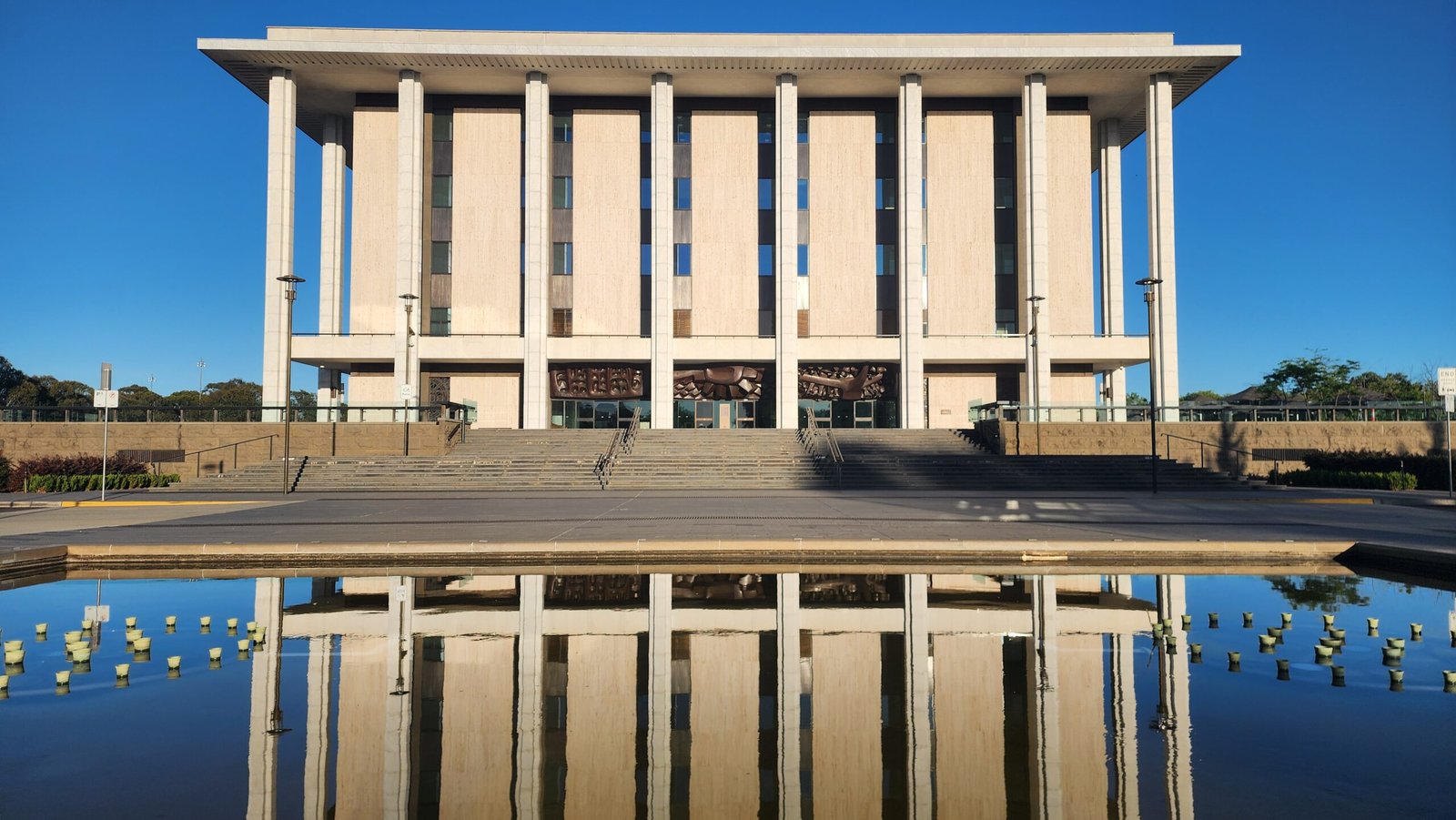
The National Library’s main building is one of Canberra’s significant cultural landmarks.
Located near Australia’s national cultural and political institutions, the Library occupies an important position in the national capital.
The building provides spaces for collections, research, exhibitions, public programs, administration, conservation, and other activities.
For many visitors, the building itself is an important part of the experience. A national library must provide suitable environments for preserving delicate historical materials while also creating spaces where people can study and engage with cultural collections.
Behind the public areas is a complex system of storage, preservation, cataloguing, digitisation, conservation, information technology, and collection management.
The Library’s operations are not limited to its main Canberra building. Its annual report has described major facilities including the Parkes Place main building and repository facilities in Hume, Canberra.
Large national collections require specialised storage because different materials have different preservation requirements.
Paper, photographs, magnetic tape, film, digital storage media, maps, manuscripts, books, and paintings cannot all be stored in exactly the same way.
Temperature, humidity, light exposure, security, handling, packaging, and environmental conditions can all affect the lifespan of collection materials.
5. The Importance of the National Library’s Collections
The collections of the National Library of Australia are central to its identity.
The Library’s Australian holdings are described as a comprehensive collection of materials relating to Australia and Australians. They include published and unpublished materials in many formats.
These collections are valuable because they allow researchers to study Australia from multiple perspectives.
For example, a historian researching Australian politics might use parliamentary publications and newspapers.
A literary researcher might examine manuscripts, first editions, letters, and authors’ papers.
A family historian might investigate newspapers, photographs, maps, diaries, and other records.
A social historian might study advertisements, magazines, oral histories, photographs, and personal correspondence.
A researcher of Australian Indigenous history may use photographs, recordings, language resources, manuscripts, maps, and other materials, while also needing to consider cultural protocols and community perspectives.
The strength of a national library is therefore not only the number of objects it holds. It is also the diversity of evidence available for research.
6. Books and Published Materials
Books remain an important component of the National Library’s collections.
Australian publishing has changed dramatically over time. Early colonial publications were followed by nineteenth-century newspapers and books, twentieth-century mass publishing, modern academic publications, children’s literature, popular magazines, specialist publications, and digital publishing.
The Library collects Australian publications as part of its national collecting responsibilities.
Its collections also include selected overseas materials that support research and complement Australian holdings.
Rare books can be especially valuable because they may provide evidence of how people understood Australia and the wider world at particular points in history.
Some books are important because of their age. Others are important because of their provenance, annotations, illustrations, authorship, subject matter, or connection to significant people and events.
7. Newspapers and Periodicals
Newspapers are among the most useful historical sources preserved by the National Library.
They provide information about everyday life as well as major events.
A newspaper can reveal what people were reading, buying, discussing, celebrating, and debating.
Researchers can use newspapers to study:
- Political history
- Local communities
- Business
- Sport
- Migration
- Advertising
- Entertainment
- Education
- Crime reporting
- Social attitudes
- Indigenous history
- Women’s history
- Labour history
- War and military history
- Economic change
- Natural disasters
- Public health
- Technology
- Popular culture
The digitisation of newspapers has transformed historical research.
Instead of travelling to a library and searching through physical newspaper volumes, researchers can often search digitised material online.
This is one reason Trove has become such an important research tool.
8. Manuscripts and Personal Papers
Manuscripts provide a different kind of historical evidence from published books.
A published book usually represents a finished work. A manuscript can reveal the process behind that work.
Personal papers may include:
- Letters
- Diaries
- Draft manuscripts
- Notebooks
- Business records
- Family correspondence
- Photographs
- Personal documents
- Scrapbooks
- Research notes
- Speeches
- Records of organisations
These materials can provide insights into the lives of writers, politicians, artists, scientists, businesspeople, activists, explorers, and other Australians.
For literary scholars, authors’ papers can be especially important.
Drafts can show how a novel, poem, speech, or essay developed. Letters can reveal relationships and intellectual networks. Diaries can provide evidence of everyday experiences.
Because many manuscript collections are unique, preservation is especially important.
9. Maps and Geographic Collections
Maps are another major category of the National Library’s collections.
Maps can tell stories about exploration, settlement, transportation, land use, political boundaries, urban development, Indigenous places, environmental change, and economic activity.
Historical maps can be compared with modern maps to understand how landscapes have changed.
A map showing an early settlement may look very different from a modern map of the same location.
Researchers can use cartographic materials to investigate:
- Exploration
- Colonial history
- Indigenous geography
- Land administration
- Urban development
- Transport networks
- Military planning
- Environmental change
- Agriculture
- Mining
- Maritime history
Maps are also valuable visual documents. They combine geographical information with historical design, language, symbols, and political assumptions.
10. Photographs and Visual Materials
Photographs are among the most powerful sources of historical information.
The National Library’s visual collections help document people, places, events, buildings, landscapes, occupations, communities, and everyday life.
Photographs can show details that may not appear in written records.
For example, an old photograph may reveal clothing, street layouts, advertising signs, transport systems, architecture, tools, working conditions, or social activities.
Photographs also create important questions for researchers.
Who took the photograph?
Why was it taken?
Who is pictured?
Where was it created?
What was the original purpose?
How has the image been preserved?
What information might be missing?
These questions help researchers interpret visual evidence carefully.
11. Oral History Collections
Not all history is written down.
Oral history provides an opportunity to preserve people’s memories, experiences, knowledge, and perspectives through recorded interviews.
Oral histories can be particularly useful when studying events or communities for which written records are incomplete.
They may document:
- Personal experiences
- Migration
- War
- Work
- Family life
- Cultural traditions
- Political experiences
- Community history
- Performing arts
- Indigenous experiences
- Social change
Oral history also creates a record of voices that may not appear prominently in conventional published sources.
At the same time, oral histories must be interpreted carefully. Memory can change over time, and personal recollections represent individual perspectives.
For researchers, oral histories are therefore valuable sources that can be compared with other documentary evidence.
12. Australian Indigenous Collections
Australian Indigenous history and culture are important parts of the country’s documentary heritage.
The National Library’s collecting information identifies strengths in materials relating to Australian Aboriginal and Torres Strait Islander languages and other areas of Indigenous Australian heritage.
Such materials can include publications, photographs, manuscripts, recordings, maps, oral histories, language resources, and other documentary materials.
Research involving Indigenous collections requires particular care.
Historical collections may contain culturally sensitive information or materials created under circumstances that do not reflect contemporary community expectations.
Libraries and researchers therefore increasingly consider cultural protocols, permissions, Indigenous knowledge, community authority, and appropriate access.
Preserving materials is important, but preservation must be combined with responsible access and interpretation.
13. Asian and Pacific Collections
The National Library also has significant collections relating to Asia and the Pacific.
These collections complement its Australian holdings and support research into Australia’s regional relationships.
Australia has longstanding historical, cultural, economic, diplomatic, and educational connections with countries throughout Asia and the Pacific.
The Library’s Asian collections have developed as an important research resource.
The Library’s collection information also identifies significant areas of language and literature research, including materials relating to Chinese, Tibetan, Manchu, Mongolian, Indonesian, French, Spanish, Italian, Portuguese, and other languages and literary traditions.
Such collections demonstrate that a national library can have an international research role while maintaining a strong national focus.
14. Music Collections
Music is another important part of Australia’s cultural heritage.
Music collections can include printed music, recordings, manuscripts, photographs, personal papers, and archival material relating to performers and composers.
Music researchers can use such resources to study the development of Australian musical culture.
The collections can also preserve evidence of popular music, classical music, folk traditions, performance history, and other forms of musical activity.
Audio preservation presents special technical challenges.
Older recordings can deteriorate, and playback equipment may become obsolete.
Digitisation can help preserve access to historical audio materials, although the preservation of digital files also requires long-term technical management.
15. Ephemera and Everyday History
One of the most interesting aspects of national library collections is the preservation of material that people might once have considered temporary or unimportant.
This type of material is often called ephemera.
Examples may include:
- Posters
- Brochures
- Invitations
- Tickets
- Menus
- Advertisements
- Political leaflets
- Program guides
- Trade catalogues
- Calendars
- Postcards
- Promotional material
Ephemera can provide valuable evidence about everyday life.
A theatre program can tell researchers what people watched.
A restaurant menu can show historical food prices and tastes.
An advertisement can reveal contemporary language and social attitudes.
A political leaflet can document how campaigns communicated with voters.
Such materials can therefore become valuable historical evidence long after their original purpose has disappeared.
16. Digital Collections
Modern national libraries must collect digital information.
The internet has become one of the most important publishing environments in human history.
Governments publish online.
Newspapers publish online.
Businesses create websites.
Researchers release digital reports.
Communities create online resources.
Individuals publish blogs, photographs, videos, and other content.
Much of this information can disappear quickly.
Websites may be redesigned, domains may expire, databases may be closed, and digital files may become inaccessible.
For this reason, the National Library has developed digital collecting and preservation programs.
The Library’s collecting strategy explicitly recognises digital material as part of Australia’s documentary heritage.
17. PANDORA: Australia’s Web Archive
One of the National Library’s best-known digital preservation initiatives is PANDORA, Australia’s Web Archive.
PANDORA was established by the National Library in 1996 to collect and preserve online publications relating to Australia and Australians.
The creation of PANDORA represented an important shift in national collecting.
The Library recognised that Australian documentary heritage was increasingly being published on the web.
If online information was not preserved, significant parts of Australia’s history could disappear.
PANDORA therefore developed as a selective web archive.
It includes websites and online publications documenting Australia’s cultural, social, political, and community life, as well as significant events.
The archive has also involved cooperation with other Australian collecting and cultural agencies.
This collaborative approach is important because no single organisation can preserve every website published in a country.
18. Trove and Its Importance
Trove is one of the most widely recognised services associated with Australia’s cultural heritage infrastructure.
It allows users to search across collections from many Australian libraries, archives, museums, universities, and other organisations.
For ordinary users, Trove can be useful for discovering historical information.
For researchers, it can be an essential starting point.
A person researching an ancestor might search historical newspapers.
A student researching Australian history might find books, photographs, maps, newspapers, and other resources.
A journalist might use historical material to investigate the background of a contemporary topic.
A writer might use old advertisements or newspapers to understand the language and culture of a particular period.
Trove demonstrates the value of connecting collections rather than leaving them isolated in individual institutions.
19. Digitisation at the National Library
Digitisation is one of the most important activities undertaken by modern libraries.
Digitisation involves converting physical or analogue material into digital formats.
This may involve scanning:
- Books
- Newspapers
- Manuscripts
- Photographs
- Maps
- Posters
- Documents
- Music
- Audio recordings
- Other historical materials
Digitisation can improve access because researchers can consult materials remotely.
It can also reduce the need to handle fragile originals.
However, digitisation does not mean that the original physical object becomes unnecessary.
The original may contain information that a digital image cannot fully reproduce.
For example, paper texture, binding, annotations, physical dimensions, colour characteristics, and three-dimensional features may be important.
Digital preservation therefore works alongside physical conservation.
20. Preservation and Conservation
Preserving a national collection is a long-term responsibility.
Materials deteriorate naturally.
Paper can become brittle.
Photographs can fade.
Magnetic tapes can degrade.
Film can deteriorate.
Digital files can become unreadable.
Storage media can fail.
Software and hardware can become obsolete.
Conservation professionals work to reduce these risks.
Preservation may involve controlled storage environments, protective packaging, careful handling, repair, digitisation, migration of digital files, and monitoring of collection conditions.
The Library’s annual reports demonstrate the scale and complexity of managing a national collection, including collecting, digitisation, preservation, services, repositories, and digital infrastructure.
21. Research Services
The National Library serves researchers from Australia and around the world.
Researchers may visit Canberra to work with materials that cannot be fully accessed online.
Reference and research services help users identify relevant resources.
A research project may begin with a simple question and lead to many different collections.
For example, someone researching an Australian writer may need to examine:
- Published books
- Manuscripts
- Letters
- Photographs
- Newspaper articles
- Interviews
- Personal papers
- Biographical resources
The Library’s catalogues and digital discovery tools help researchers identify these materials.
22. Services for Students
Students can benefit greatly from national library collections.
School and university assignments often require reliable primary and secondary sources.
The National Library provides access to materials that can support research in subjects such as:
- History
- Literature
- Geography
- Politics
- Sociology
- Art
- Music
- Indigenous studies
- Australian studies
- Media studies
- Cultural studies
Digital collections are especially useful for students who cannot easily travel to Canberra.
Teachers can also use digitised resources to introduce students to primary sources.
Instead of reading only a textbook description of an historical event, students can examine an original newspaper, photograph, map, letter, or government document.
This can make historical study more evidence-based and engaging.
23. Exhibitions and Public Programs
A national library is not only a research institution.
It also has a public cultural role.
Exhibitions can introduce important collection materials to visitors who may never have the opportunity to conduct specialist research.
An exhibition can bring together manuscripts, photographs, books, maps, recordings, and objects around a particular theme.
Public programs may include lectures, talks, educational activities, cultural events, and other forms of engagement.
These activities help connect national collections with the broader community.
They also demonstrate that historical collections are not simply objects stored in repositories. They can be used to encourage discussion, creativity, education, and new research.
24. The Library as a Place for Knowledge
Libraries have changed significantly in the digital age.
In the past, people often associated libraries primarily with shelves of printed books.
Today, a national library is also a digital research environment.
People can access catalogues, digitised documents, historical newspapers, photographs, databases, online exhibitions, and web archives from computers around the world.
However, physical libraries remain important.
Researchers may need to consult original manuscripts.
Rare books may only be available in controlled environments.
Special collections may contain information that has not yet been digitised.
The physical library also provides a dedicated environment for study and research.
The National Library therefore combines physical and digital knowledge infrastructure.
25. Legal Deposit and Australian Publishing
Legal deposit is an important part of Australia’s documentary heritage system.
The principle behind legal deposit is that publishers are required to deposit copies of certain publications with designated libraries.
This helps ensure that publications become part of the national record.
The development of legal deposit provisions has been important for national collecting.
In the digital era, legal deposit has expanded to address electronic publications.
The Library’s annual reporting has discussed legal deposit and National edeposit (NED) as important components of its collecting environment.
Digital legal deposit is especially important because a large proportion of modern Australian publishing takes place online.
26. National edeposit
National edeposit, commonly known as NED, supports the deposit and preservation of Australian electronic publications.
The development of digital deposit systems reflects the changing nature of publishing.
A printed book can be physically delivered to a library and placed on a shelf.
An electronic publication requires different processes.
Digital files must be transferred, stored, described, preserved, and made accessible in ways that respect copyright and other legal requirements.
National edeposit helps ensure that Australia’s digital publishing history can be preserved alongside its printed publishing history.
27. The Role of Technology
Technology has transformed almost every part of the National Library’s work.
Modern library technology supports:
- Digital catalogues
- Online discovery
- Full-text search
- Digitisation
- Digital preservation
- Web archiving
- Electronic deposit
- Metadata management
- Collection databases
- Digital exhibitions
- Remote research
The technological environment continues to evolve.
Artificial intelligence, machine learning, automated text recognition, improved scanning, digital preservation systems, and new forms of data analysis may create additional opportunities for researchers.
At the same time, technology introduces new challenges.
Digital information can be enormous in volume.
File formats can become obsolete.
Copyright restrictions can limit access.
Websites can change rapidly.
Long-term digital preservation requires continuous technical investment.
28. Why the National Library Matters to Australian History
The National Library matters because historical memory is fragile.
Without deliberate collecting and preservation, important evidence can disappear.
Consider an old newspaper.
If no copies survive, researchers may never know exactly what it reported.
Consider a personal letter.
If it is destroyed, a unique historical voice may disappear.
Consider a website documenting an important social movement.
If it is not archived, future researchers may find little evidence that the site ever existed.
A national library helps reduce this risk.
It creates an institutional memory that can survive individual lifetimes.
29. Supporting Genealogy and Family History
Genealogists and family historians are another major group of library users.
Historical newspapers can contain birth announcements, marriage notices, obituaries, advertisements, community news, and other information.
Photographs may help identify people and places.
Maps can show where families lived.
Books and local histories can provide context.
Personal papers and archival records may reveal family relationships and activities.
Trove and other digital services have made this kind of research much easier.
Someone researching a family in Australia can often begin online before travelling to a library or archive.
30. Supporting Australian Literature
The National Library has an important role in preserving Australian literary history.
Australian literature includes novels, poetry, drama, children’s books, essays, journalism, criticism, and other forms of writing.
Preserving literature means more than preserving published copies.
Authors’ manuscripts and personal papers can reveal how literary works developed.
Letters can show relationships between writers.
Drafts can demonstrate changes in language and structure.
Photographs can document literary communities.
Interviews can preserve writers’ voices and memories.
Together, these materials allow future generations to study not only Australian books but also the people and communities behind them.
31. Supporting Political and Social History
The Library’s collections also provide extensive resources for studying Australia’s political and social development.
Researchers can examine parliamentary documents, newspapers, speeches, personal papers, campaign materials, photographs, and other sources.
Political history is not limited to official government records.
Campaign posters, political advertisements, personal letters, newspaper editorials, community publications, and oral histories can all provide different perspectives.
A researcher can compare these sources to understand how political debates developed and how Australians experienced major changes.
32. The Library and Australia’s Cultural Identity
National libraries contribute to cultural identity by preserving the stories a society chooses to document.
The National Library’s focus on Australia and Australians means that its collections reflect many aspects of national life.
This includes both famous historical figures and ordinary people.
A national collection can contain the papers of major politicians alongside family photographs, local newspapers, children’s literature, community publications, and personal records.
This diversity is important.
History is not created only by famous people.
Communities, families, workers, artists, students, migrants, entrepreneurs, activists, educators, and many other groups contribute to the development of a country.
33. International Importance
Although the National Library has a strong Australian focus, its importance extends beyond Australia’s borders.
Researchers around the world study Australian history, literature, politics, geography, Indigenous cultures, migration, environmental history, and international relations.
The Library’s Asian and Pacific collections are particularly relevant to research into Australia’s regional connections.
Its digital services also make Australian documentary heritage more accessible internationally.
A researcher living outside Australia may be able to discover historical newspapers, books, photographs, maps, and other resources without travelling immediately to Canberra.
34. Challenges Facing the National Library
Modern national libraries face several major challenges.
Digital Growth
The amount of digital information produced every year is enormous.
It is impossible to preserve everything.
Libraries must develop collecting priorities to determine what is likely to have long-term cultural or historical value.
Copyright
Preserving information does not automatically mean that it can be made freely available.
Copyright law can affect how collection materials are displayed, copied, downloaded, or reused.
The National Library therefore has to balance access with legal and ethical responsibilities.
Preservation Costs
Preserving collections requires specialised facilities, technology, staff, equipment, and expertise.
Digital preservation can be particularly expensive because systems need ongoing maintenance.
Physical Deterioration
Historic materials can be fragile.
Some objects may require conservation treatment before they can be safely handled or digitised.
Cultural Sensitivity
Some historical materials require special treatment because they contain culturally sensitive information.
This is particularly important for Indigenous materials.
35. The Future of the National Library of Australia
The future of the National Library will increasingly combine physical collections with digital infrastructure.
Books, manuscripts, maps, photographs, and other physical materials will remain important.
At the same time, the Library will continue to collect digital publications and preserve online content.
Artificial intelligence may eventually help researchers analyse very large collections.
For example, automated systems can potentially assist with:
- Text recognition
- Search
- Translation
- Metadata creation
- Image analysis
- Historical data analysis
- Discovery of relationships between documents
However, technology should support rather than replace careful scholarship.
Historical documents require context.
Researchers must understand who created a document, why it was created, what its limitations are, and how it relates to other evidence.
36. Why National Libraries Are Important in the Digital Age
Some people may wonder whether physical national libraries are still necessary when so much information is available online.
The answer lies in the difference between information and preservation.
The internet contains enormous amounts of information, but online information is not necessarily permanent.
A webpage can disappear.
A company can close.
A website can change.
A digital file can become corrupted.
A platform can stop operating.
A national library provides institutional continuity.
Its responsibility is to think not only about what people need today but also what researchers may need decades or centuries from now.
The National Library’s collecting strategy reflects this long-term perspective: material collected today may become important evidence for tomorrow.
37. Visiting and Using the National Library
The National Library is open to the public, with specific access arrangements applying to different services and collections. The Australian Libraries Gateway describes the Library as open to the public and provides information about its research and collection services.
Visitors can explore public areas, exhibitions, programs, and other services.
Researchers who need specialised collection material may need to follow particular procedures.
Because rare and fragile materials require careful handling, access to some resources may involve reading-room procedures, registration, advance requests, or other conditions.
Anyone planning a research visit should check the Library’s current official information before travelling.
38. National Library of Australia and Education
The Library contributes to education at many levels.
For school students, its digitised collections can make historical evidence more accessible.
For university students, it can provide primary sources for assignments and research projects.
For postgraduate researchers, its manuscript and archival collections can support specialised scholarship.
For teachers, the Library can provide materials that help students understand Australian history through original documents.
For lifelong learners, digital collections provide opportunities to explore subjects independently.
This educational role is one of the reasons national libraries remain relevant in modern society.
39. National Library as a Memory Institution
The term “memory institution” is often used for libraries, archives, museums, and similar organisations that preserve cultural evidence.
The National Library of Australia fits this description strongly.
Its collections preserve evidence of:
- People
- Places
- Ideas
- Events
- Languages
- Literature
- Politics
- Communities
- Technologies
- Cultural practices
- Everyday life
This memory function is especially important because individual memories disappear with time.
Institutional preservation creates a shared resource for future generations.
40. Conclusion
The National Library of Australia is one of the country’s most important institutions for preserving knowledge and cultural heritage.
Its history stretches back to 1901, when the institution developed as the Commonwealth Parliamentary Library. Over the following decades, its role expanded, and the National Library Act 1960 established a strong statutory framework for its national responsibilities.
Today, the Library collects much more than books.
Its holdings include newspapers, manuscripts, maps, photographs, music, oral histories, ephemera, government publications, digital publications, websites, and other documentary resources. Its collecting strategy specifically emphasises materials relating to Australia and Australians, while its broader collections include significant overseas, Asian, and Pacific resources.
Its digital initiatives are equally important. PANDORA has preserved Australian web content since 1996, while Trove has helped make Australian cultural and historical resources discoverable online.
The Library’s significance goes beyond the preservation of old documents. Its collections support research, education, genealogy, literature, journalism, historical scholarship, cultural studies, and public understanding.
A national library represents a commitment to preserving knowledge for people who have not yet been born.
The materials collected today may become primary sources for researchers many decades from now. A newspaper published today, a website created today, a photograph taken today, or a digital publication deposited today could become valuable historical evidence in the future.
For this reason, the National Library of Australia remains an essential part of Australia’s cultural and intellectual infrastructure.
It connects the past with the present and provides resources for imagining and understanding the future.
Frequently Asked Questions About the National Library of Australia
1. Where is the National Library of Australia located?
The National Library of Australia is located in Canberra, Australian Capital Territory, Australia’s national capital. Its main building is at Parkes Place.
2. When was the National Library of Australia established?
The institution’s origins date to 1901, when it developed as the Commonwealth Parliamentary Library following Australian Federation. Its later national role was formalised through the National Library Act 1960.
3. What does the National Library of Australia collect?
The Library collects materials relating to Australia and Australians, including books, newspapers, serials, maps, music, photographs, manuscripts, oral histories, ephemera, online publications, and other documentary materials.
4. Does the National Library collect digital material?
Yes. Digital publications and online resources are an important part of its modern collecting responsibilities. The Library also operates digital preservation initiatives such as PANDORA.
5. What is PANDORA?
PANDORA is Australia’s Web Archive. It was established by the National Library in 1996 to collect and preserve Australian online publications and websites relating to Australia and Australians.
6. What is Trove?
Trove is an Australian discovery service that allows users to search across collections from libraries, archives, museums, universities, and other cultural institutions. It provides access to a wide range of historical and contemporary resources.
7. Can the public visit the National Library?
Yes. The National Library is open to the public, although particular collections and research services may have specific access conditions.
8. Can students use the National Library?
Yes. Students can use its collections and digital resources for educational research, depending on the access conditions of individual materials.
9. Does the Library have historical newspapers?
Yes. Newspapers are an important part of Australian documentary heritage and many historical newspapers have been digitised and made discoverable through Trove.
10. Does the Library preserve photographs?
Yes. Photographs form an important part of its visual collections and provide evidence about Australian people, places, communities, events, and everyday life.
11. Does the National Library have manuscripts?
Yes. The Library holds manuscripts, personal papers, correspondence, diaries, drafts, organisational records, and other unpublished materials.
12. Why are national libraries important?
National libraries preserve documentary heritage for current and future generations. They provide researchers with reliable sources and help protect historical evidence that might otherwise be lost.
13. Does the Library only collect Australian material?
No. Australian material is the central collecting focus, but the Library also holds overseas, rare book, Asian, Pacific, and other international research materials that complement its Australian collections.
14. What is the National Library Act 1960?
The National Library Act 1960 is the legislation that provides the statutory framework for the National Library and its national collecting responsibilities.
15. Why is digitisation important?
Digitisation makes many historical resources easier to discover and use while helping reduce the need to handle fragile originals. It also allows researchers around the world to access digital copies of selected materials.
16. What kinds of researchers use the National Library?
Historians, genealogists, authors, journalists, academics, students, teachers, artists, cultural researchers, librarians, and members of the public can all use its resources.
17. Does the Library preserve websites?
Yes. PANDORA was created specifically to preserve selected Australian websites and online publications as part of the country’s documentary heritage.
18. What makes the National Library different from a public library?
A public library generally focuses on providing books, information, technology, and community services to a local population. A national library has a broader responsibility to preserve the documentary heritage of an entire country.
19. Why are old newspapers useful for research?
Old newspapers provide evidence about politics, communities, businesses, entertainment, social attitudes, advertisements, historical events, and everyday life.
20. What is the future role of the National Library?
Its future role will continue to involve collecting and preserving Australian documentary heritage while expanding digital preservation, online access, research services, and new technologies for discovering and analysing historical collections.
Final Thoughts
The National Library of Australia represents the idea that a country’s knowledge should be preserved beyond the lifetime of any individual generation.
Its collections provide evidence of Australia’s changing society, culture, politics, literature, geography, communities, and everyday life. From rare books and handwritten manuscripts to newspapers, photographs, maps, recordings, websites, and digital publications, the Library preserves many different forms of Australian memory.
Its work is therefore both historical and forward-looking.
The National Library does not simply preserve yesterday. It collects today with the understanding that today’s information may become tomorrow’s history.
That long-term responsibility makes the National Library of Australia an essential institution for researchers, students, educators, writers, historians, families, and anyone interested in understanding Australia.
In the digital age, its role may be more important than ever. As information becomes increasingly distributed across websites, databases, social platforms, digital publications, and electronic records, preserving the nation’s documentary heritage requires specialised institutions with long-term responsibilities.
The National Library of Australia provides that continuity.
It connects physical collections with digital resources, historical documents with modern research, and past generations with future generations.
For anyone interested in Australian history and culture, the National Library of Australia offers a remarkable gateway into the country’s documentary heritage.
h