The British Library: A Complete History, Collections, Architecture, and Importance
Introduction
The British Library is one of the world’s most important research libraries and one of the United Kingdom’s greatest cultural institutions. Located primarily in London, with another major site in West Yorkshire, the library preserves an extraordinary collection of books, manuscripts, newspapers, maps, recordings, patents, photographs, drawings, and other forms of knowledge. Its collections span thousands of years and represent cultures, languages, religions, scientific discoveries, literary traditions, political developments, and everyday human experiences from around the world.
For many people, the word “library” suggests shelves filled with books. The British Library is much more than that. It is a major national institution dedicated to collecting, preserving, organizing, researching, and providing access to recorded knowledge. Its collections include famous historical manuscripts as well as modern publications, digital material, newspapers, music recordings, maps, stamps, and many other forms of information.
The story of the British Library is closely connected with the history of the British Museum, the development of copyright and legal deposit in Britain, the growth of printing, and the expansion of scholarship. Although the British Library became an independent institution in the twentieth century, many of its most important collections have much older origins.
Today, researchers, students, writers, historians, scientists, journalists, artists, and members of the public use the library’s resources. Its importance extends far beyond the United Kingdom because its collections document civilizations and intellectual traditions from many parts of the world.
This article explores the history of the British Library, its collections, architecture, famous treasures, services, digital resources, research importance, and continuing role in preserving knowledge for future generations.
What Is the British Library?
The British Library is the national library of the United Kingdom. It is responsible for collecting and preserving a vast range of published and recorded material and making it available for research.
Unlike an ordinary public library, the British Library is primarily a research library. It contains material that may not be available in local libraries, university libraries, or commercial databases. Some of its most valuable resources are unique or extremely rare historical documents.
The library’s collections cover a remarkable range of subjects, including:
- Literature
- History
- Science
- Technology
- Medicine
- Art
- Music
- Geography
- Philosophy
- Religion
- Politics
- Economics
- Languages
- Linguistics
- Genealogy
- Newspapers
- Cartography
- Photography
- Sound recordings
- Digital publications
The institution serves researchers from the United Kingdom and around the world. Its collections also support exhibitions, education, cultural programs, and digital research.
History of the British Library
Early Origins
The history of the British Library cannot be separated from the development of major national collections in Britain.
One important foundation was the library of the British Museum. The British Museum was established in the eighteenth century, and its collections included books, manuscripts, and other printed and written materials.
The British Museum library eventually became one of the world’s great research libraries. Over time, its collections expanded enormously.
Another important development was the growth of legal deposit. Legal deposit is a system through which publishers are required to provide copies of published works to designated libraries. This system helped create a comprehensive national collection of British publications.
The legal deposit tradition in Britain has roots going back several centuries. The British Library later inherited responsibility for collecting material under the legal deposit system.
The British Museum Library
For much of its history, many of Britain’s most important books and manuscripts were held by the British Museum.
The British Museum’s library collections grew as scholars, collectors, institutions, and governments transferred books and manuscripts to the museum.
Among the important collections that became part of the British Museum library were the King’s Library and other major historical collections.
The library attracted scholars from Britain and abroad. Researchers came to study manuscripts, early printed books, historical documents, and works in many languages.
As the collections expanded, the library increasingly required specialized facilities.
The King’s Library
One of the most famous components of the British Library’s historical collections is the King’s Library.
The King’s Library was assembled by King George III. It contained tens of thousands of books covering literature, science, history, geography, philosophy, and other subjects.
After George III’s death, the collection became associated with the British Museum.
The King’s Library is significant not only because of its size but also because it represents the intellectual interests of the eighteenth-century period.
Today, the historic collection is an important part of the British Library’s heritage.
The Separation of the British Library
A major turning point occurred in the twentieth century.
The British Library Act 1972 created the British Library as an independent institution. The new institution brought together major library collections that had previously been held by different organizations.
The British Library officially began operating as an independent organization in 1973.
This change created a national library specifically designed to manage Britain’s enormous research collections.
The new institution brought together material from several important sources, including collections associated with the British Museum, the National Central Library, the National Reference Library for Science and Invention, and other institutions.
The creation of the British Library represented a major change in the organization of national research resources.
The British Library Building in London
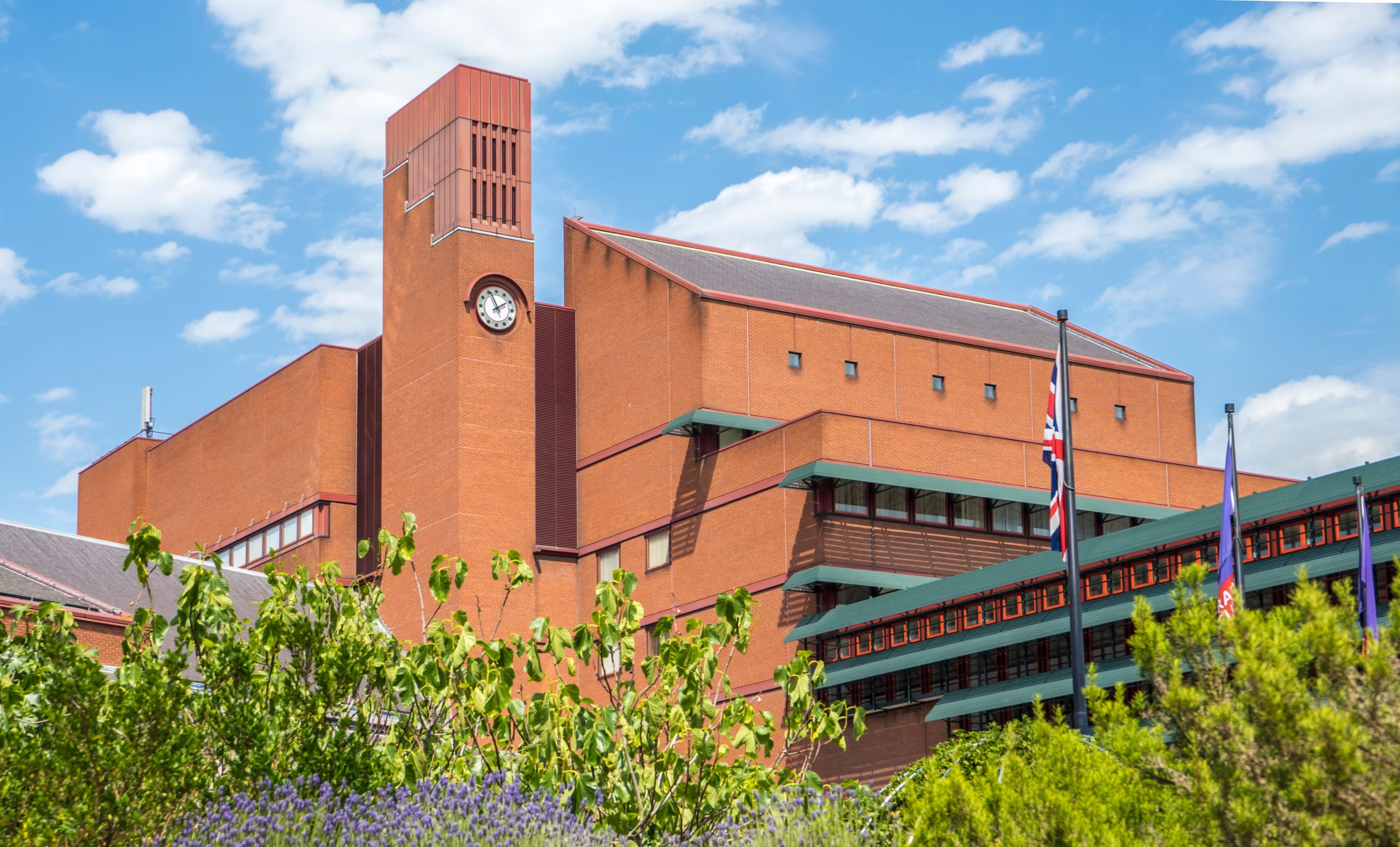
The British Library’s main building is located near King’s Cross and St Pancras in London.
The building was designed by architect Colin St John Wilson and became one of the major library buildings of the late twentieth century.
Construction took place over many years. The building was eventually opened to the public in stages, with the main building officially opened by Queen Elizabeth II in 1998.
Its architecture was designed around the needs of a modern research library.
The building contains reading rooms, exhibition spaces, conservation facilities, offices, storage areas, public spaces, and research infrastructure.
One of its most recognizable features is the large red-brick exterior.
The Famous King’s Library Tower
Inside the British Library’s St Pancras building is a large glass tower containing the historic King’s Library collection.
The tower is one of the building’s most recognizable interior features.
The books can be seen through glass, creating a striking visual connection between the historic collection and the modern library.
The design symbolizes the relationship between the past and present.
The King’s Library represents centuries of collected knowledge, while the surrounding modern building provides facilities for contemporary research.
The British Library in Boston Spa
The British Library is not located only in London.
It also operates a major site at Boston Spa in West Yorkshire.
Boston Spa plays a particularly important role in storage, document supply, preservation, and other library services.
The site provides large-scale facilities necessary for an institution with millions of items.
Because physical collections require enormous amounts of space and carefully controlled environmental conditions, a national library needs specialized storage facilities.
Boston Spa therefore plays an essential role in the British Library’s overall operations.
The Size of the British Library’s Collections
The British Library holds an enormous quantity of material.
Its collections include millions of books and many other types of resources.
The library’s holdings have been described as containing material from many centuries and from almost every part of the world.
The collection is continuously expanding because the library receives new publications through legal deposit and acquires material through other collecting programs.
The sheer scale of the collection makes the British Library one of the world’s major centers for recorded knowledge.
Books and Printed Material
Books are one of the most important parts of the British Library’s collections.
The library holds:
- Modern books
- Medieval books
- Early printed books
- Rare books
- First editions
- Academic publications
- Government publications
- Reference works
- Foreign-language books
- Children’s literature
- Religious books
- Scientific works
- Literary works
The collection covers an enormous range of subjects.
Researchers can use these resources to study everything from medieval literature to modern science.
Manuscripts
The British Library possesses an extraordinary manuscript collection.
Manuscripts are especially important because they provide direct evidence of historical cultures and intellectual traditions.
The collection includes manuscripts written on:
- Parchment
- Paper
- Papyrus
- Palm leaves
- Other historical writing materials
Many manuscripts contain illustrations, decorations, marginal notes, musical notation, maps, or other features.
Some manuscripts are thousands of years old.
The Magna Carta
One of the British Library’s most famous historical treasures is the Magna Carta.
The Magna Carta was originally issued in 1215 during the reign of King John.
It became one of the most famous documents associated with the development of constitutional and legal traditions.
The British Library holds two original 1215 copies of the Magna Carta.
The document is important because it demonstrates medieval attempts to establish limits on royal authority and define relationships between the monarch and other parts of society.
Over the centuries, Magna Carta acquired broader symbolic significance.
It is frequently associated with principles such as the rule of law and limitations on government power.
However, its original medieval context was more specific and complex than many modern summaries suggest.
The Lindisfarne Gospels
Another famous treasure is the Lindisfarne Gospels.
The manuscript was produced around the late seventh or early eighth century and is one of the great surviving examples of Insular art.
It contains the four Gospels of the Christian New Testament.
Its pages are famous for elaborate decoration, intricate patterns, vibrant colors, and highly detailed lettering.
The manuscript provides valuable evidence about religious culture, artistic traditions, writing, and book production in early medieval Britain.
The Lindisfarne Gospels are among the most recognizable manuscripts in the British Library’s collection.
The Gutenberg Bible
The British Library also holds copies of the Gutenberg Bible.
The Gutenberg Bible is associated with Johannes Gutenberg’s development of printing with movable metal type in Europe during the fifteenth century.
It is one of the most famous early printed books.
The invention and spread of printing transformed the production and distribution of written information.
Printed books could be reproduced more efficiently than hand-copied manuscripts, helping accelerate intellectual, religious, educational, and cultural change.
The Gutenberg Bible therefore represents an important moment in the history of publishing.
The Diamond Sutra
The British Library’s Asian collections contain many remarkable works.
Among them is the Diamond Sutra, a Buddhist text printed in China in 868.
It is widely recognized as the world’s oldest surviving dated printed book.
The document demonstrates the sophistication of early printing in East Asia centuries before Gutenberg’s European printing developments.
The Diamond Sutra is therefore extremely important for the history of printing and Buddhist culture.
The St Cuthbert Gospel
The St Cuthbert Gospel is another remarkable manuscript.
It is a small early medieval Gospel book associated with St Cuthbert.
Its compact size and excellent preservation make it particularly valuable to historians of medieval book production.
The manuscript provides evidence about early Christian manuscript culture in Britain.
Its binding is also historically significant.
Leonardo da Vinci’s Notebooks
The British Library has an important collection of Leonardo da Vinci’s notebooks and drawings.
Leonardo da Vinci is famous as an artist, scientist, engineer, inventor, and thinker.
His notebooks demonstrate the breadth of his curiosity.
They contain observations and ideas concerning subjects such as:
- Anatomy
- Mechanics
- Flight
- Water
- Engineering
- Geometry
- Art
- Natural phenomena
The notebooks show how Leonardo combined observation, drawing, experimentation, and theoretical thinking.
Literary Collections
The British Library has enormous importance for literary scholarship.
Its literary collections include works connected with many famous authors.
Researchers can find manuscripts, letters, drafts, notebooks, first editions, and other materials associated with writers.
Collections connected with British literature include material relating to authors such as:
- William Shakespeare
- Jane Austen
- William Blake
- Charles Dickens
- Charlotte Brontë
- Emily Brontë
- George Eliot
- Virginia Woolf
- Lewis Carroll
- Samuel Johnson
- Oscar Wilde
- Robert Burns
The library also holds important works from international literary traditions.
Shakespeare Collections
Shakespeare is one of the most important figures represented in the British Library’s collections.
The library holds early editions and other materials connected with Shakespeare and the history of his works.
The study of Shakespeare requires comparison between editions, historical contexts, textual variations, and surviving documents.
Libraries such as the British Library provide the primary sources necessary for this kind of scholarship.
Jane Austen Collections
The British Library also holds important material relating to Jane Austen.
Austen’s manuscripts are particularly valuable because surviving handwritten material provides insight into her writing process.
Her drafts reveal corrections, changes, and revisions.
This allows scholars to study not only the final published novels but also how Austen developed her prose.
Charles Dickens Collections
The library contains significant Dickens-related material.
Charles Dickens was one of Britain’s most influential nineteenth-century novelists.
His manuscripts, letters, illustrations, and printed editions help researchers understand Victorian literature and publishing.
Dickens also had a close relationship with the publishing culture of nineteenth-century Britain, making his material valuable for social and literary history.
Newspapers and Periodicals
The British Library has one of the world’s most significant newspaper collections.
Newspapers are essential historical sources because they record contemporary reactions to events.
They can be used to study:
- Wars
- Elections
- Economic changes
- Social movements
- Crime
- Sports
- Entertainment
- Technology
- International affairs
- Local history
Newspapers can reveal how people understood events at the time.
The British Library’s newspaper collections therefore provide an enormous resource for historians and researchers.
Maps
The British Library has an extensive map collection.
Maps are more than tools for navigation.
Historical maps can reveal how people understood geography and political boundaries at particular points in time.
They can also provide information about:
- Urban development
- Colonial expansion
- Transportation
- Military campaigns
- Trade
- Land ownership
- Exploration
- Environmental change
The library’s cartographic collections are valuable to historians, geographers, architects, genealogists, and researchers.
Music Collections
The British Library also preserves sound and music materials.
Its sound collections include recordings representing many genres, cultures, languages, and historical periods.
The collection can include:
- Music
- Spoken-word recordings
- Interviews
- Oral histories
- Radio broadcasts
- Traditional music
- Environmental sounds
Audio preservation is especially important because sound recordings can deteriorate over time.
Digital preservation helps ensure that recordings remain accessible to future researchers.
Sound Archive
The British Library Sound Archive is one of the world’s major collections of recorded sound.
It preserves recordings of people speaking, singing, performing music, telling stories, and describing their experiences.
Oral history is particularly valuable because it captures voices and memories that may never appear in written documents.
Researchers can use recordings to study language, accents, music, social history, anthropology, and cultural change.
Photography Collections
Photography is another important part of the library’s collections.
Photographs can document people, places, events, architecture, landscapes, scientific research, and everyday life.
Historical photographs can be valuable evidence for understanding how societies and environments have changed.
The British Library’s photographic resources complement its written and printed collections.
Stamps and Philatelic Collections
The library also has important philatelic resources.
Stamps can provide evidence about governments, political identities, historical events, transportation systems, communication networks, art, and popular culture.
Philatelic collections therefore have value beyond the hobby of stamp collecting.
Science and Technology Collections
The British Library is not only a humanities institution.
It also holds extensive scientific and technical literature.
Researchers can find historical and modern publications concerning:
- Physics
- Chemistry
- Biology
- Engineering
- Medicine
- Computing
- Mathematics
- Astronomy
- Technology
These collections are valuable for understanding how scientific knowledge developed.
Historical scientific publications can show how theories changed over time and how discoveries were communicated.
Patent Collections
The British Library has historically played an important role in providing access to patent information.
Patents document inventions and technical developments.
They can be useful to researchers studying technological history, innovation, business, engineering, and industrial development.
Asian and African Collections
One of the major strengths of the British Library is the international character of its collections.
It holds extensive material from Asia, Africa, the Middle East, and other regions.
Collections include manuscripts and printed material in numerous languages and writing systems.
Researchers can study traditions including:
- Arabic
- Persian
- Urdu
- Hindi
- Sanskrit
- Bengali
- Chinese
- Japanese
- Korean
- Tibetan
- Southeast Asian languages
- African languages
These collections are important resources for global scholarship.
South Asian Collections
The British Library has particularly significant collections relating to South Asia.
These collections contain manuscripts, books, photographs, maps, official records, and other historical materials.
Researchers can use them to investigate subjects including:
- Indian history
- Pakistani history
- Mughal history
- Colonial history
- South Asian literature
- Religion
- Languages
- Art
- Architecture
- Political history
The collections provide valuable primary-source material for scholars.
India Office Records
The India Office Records are among the British Library’s major historical collections.
They contain extensive documentation connected with the administration and history of British India.
The records include correspondence, administrative papers, maps, photographs, reports, and other documents.
These materials can be used to study the political, economic, social, and cultural history of South Asia.
Because colonial records reflect the institutions that created them, researchers need to consider their perspective and limitations.
They are nevertheless important primary sources when studied alongside other evidence.
Digitization at the British Library
A modern national library cannot depend entirely on physical access.
The British Library has therefore invested heavily in digitization.
Digitization involves creating digital copies of physical materials.
Digital collections can include:
- Manuscripts
- Books
- Newspapers
- Maps
- Photographs
- Sound recordings
- Historical documents
Digitization makes rare materials available to researchers who may be unable to travel to London or other library locations.
The British Library Online
The British Library provides a large amount of information and digital material online.
Its website allows users to discover collections, exhibitions, research resources, catalog records, and educational materials.
Digital access has become increasingly important because researchers around the world can explore collections remotely.
Online resources also support teachers, students, writers, and independent researchers.
The British Library’s Reading Rooms
The library has reading rooms where registered users can consult materials.
Reading rooms are designed for serious research.
Because many library materials are rare or fragile, researchers must follow rules designed to protect them.
Depending on the material, access may require advance ordering.
Readers generally need to handle documents carefully and follow instructions from library staff.
Who Can Use the British Library?
The British Library serves a wide range of users.
These include:
- University students
- Professors
- Historians
- Writers
- Journalists
- Scientists
- Genealogists
- Independent researchers
- Artists
- Musicians
- Authors
- Members of the public
Access arrangements can vary depending on the type of material and the user’s research needs.
Some resources are available online without visiting the library.
Exhibitions
The British Library regularly organizes exhibitions.
These exhibitions bring selected treasures from the collections to a wider public audience.
Exhibitions can focus on subjects such as:
- Literature
- Music
- History
- Religion
- Science
- Art
- Popular culture
- Politics
- Technology
Exhibitions allow visitors to see rare materials that would otherwise mainly be used by researchers.
Educational Programs
Education is an important part of the British Library’s mission.
The institution develops resources for schools, universities, teachers, and lifelong learners.
Educational materials can help students explore historical documents and primary sources.
Instead of learning history only from modern textbooks, students can examine original documents and consider how historical evidence is created and interpreted.
The Role of Conservation
Preserving physical collections is a major responsibility.
Books and manuscripts can be damaged by:
- Humidity
- Temperature
- Light
- Dust
- Handling
- Pests
- Chemical deterioration
- Natural aging
The British Library therefore employs conservation specialists who work to protect collections.
Conservation may involve cleaning, repairing, stabilizing, or creating appropriate storage conditions.
Digital Preservation
Digital materials create a different set of preservation challenges.
A digital file can become inaccessible if:
- The storage medium fails
- Software becomes obsolete
- File formats become unsupported
- Data becomes corrupted
- Hardware disappears
Digital preservation therefore requires continuous management.
For a modern national library, preserving digital information is just as important as protecting historical paper documents.
Legal Deposit
Legal deposit is one of the most important mechanisms supporting the British Library’s national collection.
Under legal deposit arrangements, publishers provide copies of publications to designated libraries.
This system helps ensure that Britain’s published intellectual record is preserved.
It includes far more than traditional printed books.
Modern publishing includes:
- Websites
- E-books
- Online journals
- Digital newspapers
- Other electronic publications
The expansion of legal deposit into the digital world has transformed national collecting.
Why Legal Deposit Matters
Without systematic collecting, many publications could disappear.
Commercial publishers may stop selling old books.
Websites can disappear.
Digital publications can become difficult to access.
Legal deposit provides a framework for preserving a broad national record.
This makes the British Library an important part of the UK’s cultural memory.
The British Library and Research
Research is central to the library’s mission.
Researchers use its collections to locate primary and secondary sources.
Primary sources include original documents, manuscripts, newspapers, maps, photographs, recordings, and other historical materials.
Secondary sources include later scholarly interpretations.
By bringing these resources together, the British Library supports detailed research across many academic disciplines.
The British Library and Genealogy
Genealogists also benefit from library collections.
Historical newspapers, books, maps, manuscripts, directories, and other records can help people investigate family histories.
Genealogical research often requires combining evidence from multiple sources.
The British Library can provide contextual material even when a specific family record is held elsewhere.
Importance for Historians
Historians depend heavily on archives and libraries.
The British Library contains evidence covering enormous periods of history.
A historian studying a particular event might consult:
- Newspapers
- Government documents
- Personal letters
- Maps
- Books
- Photographs
- Diaries
- Statistical publications
Using multiple sources allows researchers to compare perspectives and identify inconsistencies.
Importance for Writers
Writers can use the British Library for background research.
Historical novelists may investigate clothing, geography, language, politics, transportation, architecture, and social customs.
Nonfiction writers can use books, manuscripts, newspapers, and archival sources.
The library can therefore support both academic and creative writing.
Importance for Students
Students can benefit from the British Library’s resources when preparing:
- Essays
- Research papers
- Theses
- Dissertations
- Presentations
- Projects
The library provides access to sources that may not be available through ordinary school or local library collections.
Students can also learn how professional researchers evaluate evidence.
A Symbol of Knowledge
The British Library has become a symbol of knowledge and scholarship.
Its collections demonstrate the extraordinary variety of human intellectual activity.
A single institution can contain evidence about:
- Ancient civilizations
- Medieval Europe
- Asian literature
- African cultures
- Scientific revolutions
- Industrial development
- Modern popular culture
This diversity is one of its defining characteristics.
Challenges Facing the British Library
Like other major cultural institutions, the British Library faces challenges.
These include:
- Preserving aging physical materials
- Managing digital information
- Funding conservation
- Providing global digital access
- Protecting rare objects
- Managing enormous collections
- Supporting modern research
- Adapting to technological change
The library must balance preservation with access.
If rare materials are handled too frequently, they may deteriorate. If they are kept inaccessible, their research value is reduced.
Digital copies can help solve part of this problem, but digitization itself requires significant resources.
The Future of the British Library
The future of the British Library will increasingly involve digital technology.
Artificial intelligence, machine learning, improved search systems, digital humanities, optical character recognition, and large-scale digitization are changing how researchers work with historical collections.
Researchers may increasingly analyze thousands or millions of documents using computational methods.
At the same time, physical manuscripts and books will remain important.
A digital scan can provide access to an image, but the original object may contain physical information that a digital copy cannot fully reproduce.
The future therefore requires both physical preservation and digital innovation.
Why the British Library Matters to the World
Although it is the national library of the United Kingdom, the British Library has international significance.
Its collections document many cultures and languages.
Researchers from around the world can use its resources to study global history.
The library’s digital projects also make selected materials accessible internationally.
Its importance therefore extends beyond Britain’s borders.
British Library and the Preservation of Human Knowledge
Libraries are often described as guardians of knowledge.
The British Library demonstrates why that role matters.
Human knowledge is vulnerable.
Books can be destroyed.
Manuscripts can deteriorate.
Languages can disappear.
Websites can vanish.
Digital files can become inaccessible.
Preservation institutions provide continuity between generations.
A manuscript created centuries ago can still be studied today because people preserved it.
A modern digital publication may similarly need preservation so that researchers hundreds of years from now can access it.
Interesting Facts About the British Library
Here are several interesting facts about the British Library:
1. It is the national library of the United Kingdom
The British Library serves as the UK’s national library and maintains an extensive national research collection.
2. Its history is older than the institution itself
Although the British Library became independent in 1973, many of its collections originated centuries earlier.
3. It holds the Magna Carta
The library holds two surviving 1215 copies of Magna Carta.
4. It has the Lindisfarne Gospels
The Lindisfarne Gospels are among its most famous illuminated manuscripts.
5. It contains early printed books
Its collections include copies and examples associated with the early history of European printing.
6. It has major Asian collections
Its collections cover numerous Asian languages and cultural traditions.
7. It has an enormous newspaper collection
Historical newspapers provide researchers with evidence of past events and societies.
8. It preserves sound
The library collects music, speech, interviews, oral histories, and other recordings.
9. It has major map collections
Historical maps help researchers understand changing landscapes and political boundaries.
10. It has a major site in West Yorkshire
The Boston Spa site supports storage and other large-scale library functions.
Visiting the British Library
Visitors can explore public spaces and exhibitions at the London site.
People interested in research may need to register for reader access.
Visitors should check current information before traveling because opening hours, exhibition schedules, access requirements, and services can change.
The library’s official website provides current information about visiting, collections, exhibitions, and research services.
How to Research at the British Library
A researcher planning to use the British Library can follow a structured approach.
Step 1: Define Your Research Question
Start by identifying exactly what you want to investigate.
For example:
“How did newspapers describe the Industrial Revolution?”
is more useful than simply searching for “Industrial Revolution.”
Step 2: Search the Catalogue
Use the library’s catalogue to identify books, manuscripts, newspapers, and other materials.
Step 3: Identify Primary Sources
Look for original documents that can provide direct evidence.
Step 4: Compare Sources
Avoid depending on a single source.
Compare different newspapers, books, documents, and scholarly interpretations.
Step 5: Record Citations
Keep detailed notes about titles, authors, dates, shelfmarks, and other identifying information.
Step 6: Evaluate Evidence
Consider who created a source, why it was created, and what limitations it may have.
The British Library in the Digital Age
The definition of a library has changed dramatically.
In the past, knowledge was primarily stored in physical objects.
Today, information exists in many forms:
- Websites
- Databases
- E-books
- Digital photographs
- Audio files
- Video
- Social media
- Online newspapers
- Electronic journals
A national library must therefore collect and preserve both physical and digital knowledge.
The British Library’s role continues to evolve in response to this changing information environment.
The Cultural Importance of Libraries
The British Library also illustrates the wider cultural importance of libraries.
Libraries are not simply places where people borrow books.
They can serve as:
- Research centers
- Cultural archives
- Educational institutions
- Community spaces
- Preservation centers
- Digital information hubs
- Places for public learning
A national library has an additional responsibility: preserving material that represents a country’s intellectual and cultural history.
Conclusion
The British Library is one of the world’s great centers of knowledge and research. Its history extends back long before the institution became independent in 1973, with many of its collections originating in earlier national and scholarly collections.
From the Magna Carta and Lindisfarne Gospels to early printed books, maps, newspapers, scientific publications, photographs, music recordings, and digital resources, the library preserves an extraordinary record of human thought and creativity.
Its importance lies not only in the number of items it holds but also in the diversity and historical value of those collections.
The British Library connects the past with the present. Medieval manuscripts can be studied alongside modern publications. Historical newspapers can be compared with contemporary research. Physical books can coexist with digital archives.
Its work in conservation, digitization, legal deposit, research support, education, and public exhibitions ensures that knowledge remains available to future generations.
As technology continues to change the way information is created and shared, the British Library’s mission becomes even more important. The formats of knowledge may change, but the fundamental responsibility remains the same: collect, preserve, organize, and provide access to the recorded heritage of humanity.
For historians, students, writers, scientists, artists, genealogists, and curious members of the public, the British Library represents an extraordinary doorway into the world’s intellectual and cultural history.
Its collections remind us that knowledge is not only something created today. It is something inherited, preserved, questioned, studied, and passed from one generation to another.
The British Library stands as one of the major institutions carrying that responsibility into the future.