National Library of Spain: History, Collections, Architecture, Services, and Cultural Importance
Introduction
The National Library of Spain, officially known as the Biblioteca Nacional de España (BNE), is one of the most important libraries in Spain and one of the major cultural institutions in Europe. Located in Madrid, the library preserves an enormous collection of books, manuscripts, maps, drawings, photographs, prints, newspapers, music, and other documentary materials that represent centuries of Spanish and international intellectual and cultural history.
A national library has a special responsibility that goes beyond lending books to readers. Its primary mission is to collect, preserve, organize, research, and make accessible the documentary heritage of a country. The National Library of Spain performs this role for Spain by protecting materials connected with Spanish literature, history, language, art, science, music, journalism, and many other fields.
The history of the National Library of Spain is closely connected with the development of modern Spain. Since its establishment in the early eighteenth century, the institution has experienced major political, social, technological, and cultural changes. It began as a royal library and gradually developed into a national institution serving researchers, students, scholars, and the wider public.
Today, the BNE combines traditional library functions with modern digital preservation and access. Its digital initiatives have made thousands of historical documents available online, allowing researchers and members of the public around the world to explore important parts of Spain’s documentary heritage.
This article explores the history, architecture, collections, services, digital resources, cultural importance, and future of the National Library of Spain.
What Is the National Library of Spain?
The National Library of Spain is Spain’s principal institution for the preservation of the country’s documentary heritage. In Spanish, its official name is Biblioteca Nacional de España.
The library is based in Madrid and operates as a major research and cultural institution. It collects and preserves publications produced in Spain as well as important works relating to Spanish culture and history.
The institution’s collections cover a remarkably wide range of subjects and formats. They include:
- Printed books
- Manuscripts
- Incunabula
- Maps
- Atlases
- Prints
- Drawings
- Photographs
- Newspapers
- Magazines
- Musical scores
- Recordings
- Ephemera
- Digital publications
- Historical documents
Because of the enormous variety of its holdings, the National Library of Spain is not simply a place where people go to read books. It is also an archive of national memory.
A Brief History of the National Library of Spain
The history of the National Library of Spain begins in the eighteenth century during the reign of King Philip V.
Foundation in 1712
The institution was founded in 1712 as the Public Library of the Palace. Its establishment formed part of the Bourbon monarchy’s efforts to promote learning, education, and intellectual culture.
The library was initially connected with the royal court. At the time, European monarchies were increasingly interested in creating libraries and cultural institutions that could support scholarship and preserve important works.
Spain already possessed extensive manuscript and printed collections, but the creation of a public royal library provided an organized institutional framework for preserving and making knowledge available.
The Royal Library and Its Early Development
In its early years, the library was closely associated with the monarchy. Its collections were developed through several different channels.
Books from royal collections were incorporated into the institution. The library also benefited from acquisitions and transfers from religious institutions and other sources.
The eighteenth century was a period of intellectual change throughout Europe. The Enlightenment encouraged greater interest in science, philosophy, history, literature, languages, and education.
The royal library became an important center for scholarly activity in Spain.
Its role gradually expanded beyond the private interests of the royal household. Scholars and qualified readers gained opportunities to consult its collections.
The Library Becomes a National Institution
Over time, the institution’s identity changed from a royal library into a national library serving the country as a whole.
One of the most important developments was the introduction of legal deposit arrangements. Legal deposit requires publishers or printers to provide copies of publications to designated institutions.
This system has been extremely important for the development of national library collections.
By receiving publications produced in Spain, the library could preserve an ongoing record of the country’s publishing output.
This transformed the institution into a major repository of Spanish intellectual production.
The Nineteenth Century
The nineteenth century brought major changes to Spanish society and politics.
Spain experienced political instability, constitutional developments, conflicts, changes of government, and social transformation. These developments affected cultural institutions, including libraries.
During this period, the national library continued expanding its collections.
The nineteenth century also witnessed rapid growth in publishing, journalism, science, education, and literary production.
As literacy increased and printing became more widespread, the volume of material that the library needed to collect and preserve also increased.
The institution increasingly became an essential resource for scholars researching Spanish history and culture.
Development of the Library’s Collections
One of the most remarkable characteristics of the National Library of Spain is the breadth of its collections.
The library does not focus exclusively on modern books. It preserves materials from many different historical periods.
Its holdings can help researchers investigate subjects ranging from medieval manuscripts and early printing to modern newspapers, photography, music, and digital publications.
The collections are particularly important for studying the Spanish language and literature.
Researchers can find works associated with major Spanish authors, literary movements, historical periods, and cultural traditions.
Manuscripts and Historical Documents
Manuscripts form one of the most valuable parts of the library’s heritage.
Manuscripts can provide information that cannot always be found in later printed editions. They may contain original literary works, correspondence, historical records, religious texts, scientific writings, personal notes, and other documents.
For historians and literary scholars, manuscripts can reveal how ideas developed and how texts changed over time.
The National Library of Spain preserves manuscripts from different periods, making it an important center for the study of Spanish and European history.
Incunabula
Another important part of the collection is its incunabula.
The term “incunabula” refers to books printed in Europe before the year 1501, during the earliest period of European printing.
These books are particularly valuable because they document the development of printing technology and the transition from manuscript culture to mass-produced books.
Early printed works can tell researchers about:
- Printing techniques
- Typography
- Book design
- Paper production
- Publishing history
- Religious culture
- Education
- European intellectual life
The National Library of Spain’s early printed collections therefore have major historical importance.
Spanish Literature
Spanish literature occupies a central position within the National Library’s collections.
Spain has produced some of the world’s most influential writers and literary works.
The library preserves editions, manuscripts, documents, and other materials associated with Spanish literary history.
Its collections are particularly useful for studying writers and works from different periods, including medieval literature, the Golden Age, the Enlightenment, nineteenth-century literature, and modern Spanish writing.
Researchers can use these materials to investigate how Spanish literature developed over hundreds of years.
Miguel de Cervantes and Don Quixote
Among the most famous figures associated with Spanish literary heritage is Miguel de Cervantes.
Cervantes is internationally recognized as the author of Don Quixote, one of the most influential works in world literature.
The National Library of Spain preserves important materials connected with Cervantes and the history of Don Quixote.
The work has been translated into numerous languages and has influenced literature around the world.
The library’s Cervantes-related collections are therefore important not only to Spain but also to international literary scholarship.
Other Literary Heritage
The library’s literary holdings extend far beyond Cervantes.
Researchers can investigate many major periods and authors of Spanish and Hispanic literature.
The collections can support research into:
- Medieval Spanish texts
- Renaissance literature
- Baroque writing
- The Spanish Golden Age
- Enlightenment literature
- Romanticism
- Realism
- Modernism
- Twentieth-century literature
- Contemporary publishing
The library also preserves literary works in languages associated with Spain’s diverse cultural traditions.
Newspapers and Periodicals
Newspapers and magazines are another major part of the National Library of Spain’s documentary heritage.
Periodicals are especially valuable for historians because they provide evidence of how people experienced events at particular moments.
A newspaper can document:
- Political events
- Economic developments
- Social changes
- Wars
- Cultural movements
- Scientific discoveries
- Sports
- Entertainment
- Public debates
- Everyday life
Historical newspapers can therefore serve as primary sources for understanding Spanish society.
Maps and Geographic Collections
The National Library of Spain also has significant cartographic collections.
Maps are valuable historical documents because they show how people understood geography at different times.
Historical maps can reveal:
- Changing political boundaries
- Exploration
- Colonial expansion
- Trade routes
- Urban development
- Transportation networks
- Scientific knowledge
- Changes in place names
The library’s maps and atlases are particularly valuable for historians, geographers, researchers, and scholars of exploration.
Prints and Drawings
The institution also preserves an important collection of prints and drawings.
These materials provide visual evidence of Spanish and European artistic and cultural history.
Prints were historically important because they allowed images to be reproduced and distributed more widely than unique paintings or drawings.
They played roles in:
- Art
- Journalism
- Education
- Political communication
- Religious culture
- Scientific illustration
The National Library’s graphic collections therefore provide another way to understand historical society.
Photographic Collections
Photography transformed the way people recorded history.
The National Library of Spain preserves significant photographic materials that document people, places, events, architecture, culture, and everyday life.
Historical photographs can provide researchers with visual evidence that complements written documents.
They can help answer questions about:
- Urban development
- Fashion
- Architecture
- Family life
- Public events
- Transportation
- Landscapes
- Social conditions
Photography has therefore become an important part of the library’s modern documentary heritage.
Music Collections
The National Library also preserves musical materials.
These include musical scores and other resources related to Spain’s musical heritage.
Music collections are valuable for understanding composers, performers, musical traditions, and the development of music in different historical periods.
Researchers can study both classical and other forms of musical culture through the library’s resources.
Digital Collections
Modern national libraries must preserve not only physical publications but also digital information.
The National Library of Spain has developed digital initiatives that allow users to access large numbers of digitized materials online.
Digital collections are important for several reasons.
First, digitization allows fragile historical documents to be consulted without unnecessary handling of the original materials.
Second, digital access allows researchers from outside Madrid or Spain to study the collections.
Third, digitization helps protect cultural heritage by creating additional copies of important materials.
Biblioteca Digital Hispánica
One of the library’s major digital projects is the Biblioteca Digital Hispánica.
The Biblioteca Digital Hispánica provides online access to digitized materials from the National Library’s collections.
Users can explore historical books, manuscripts, maps, photographs, prints, drawings, and other documents.
Digital libraries such as this have changed the way researchers work.
A scholar no longer necessarily needs to travel to Madrid simply to inspect a historical document. When a digitized version is available, it can be examined online from another country.
This is particularly valuable for international research.
The Library and Digital Preservation
Digitization does not mean that physical preservation is no longer important.
Digital files themselves require preservation.
Technology changes rapidly, and digital formats can become obsolete.
The library therefore faces the challenge of preserving both traditional physical materials and born-digital publications.
This requires:
- Digital storage
- Metadata
- File management
- Format migration
- Digital preservation strategies
- Data security
- Long-term access planning
The modern national library is therefore both a traditional heritage institution and a technology organization.
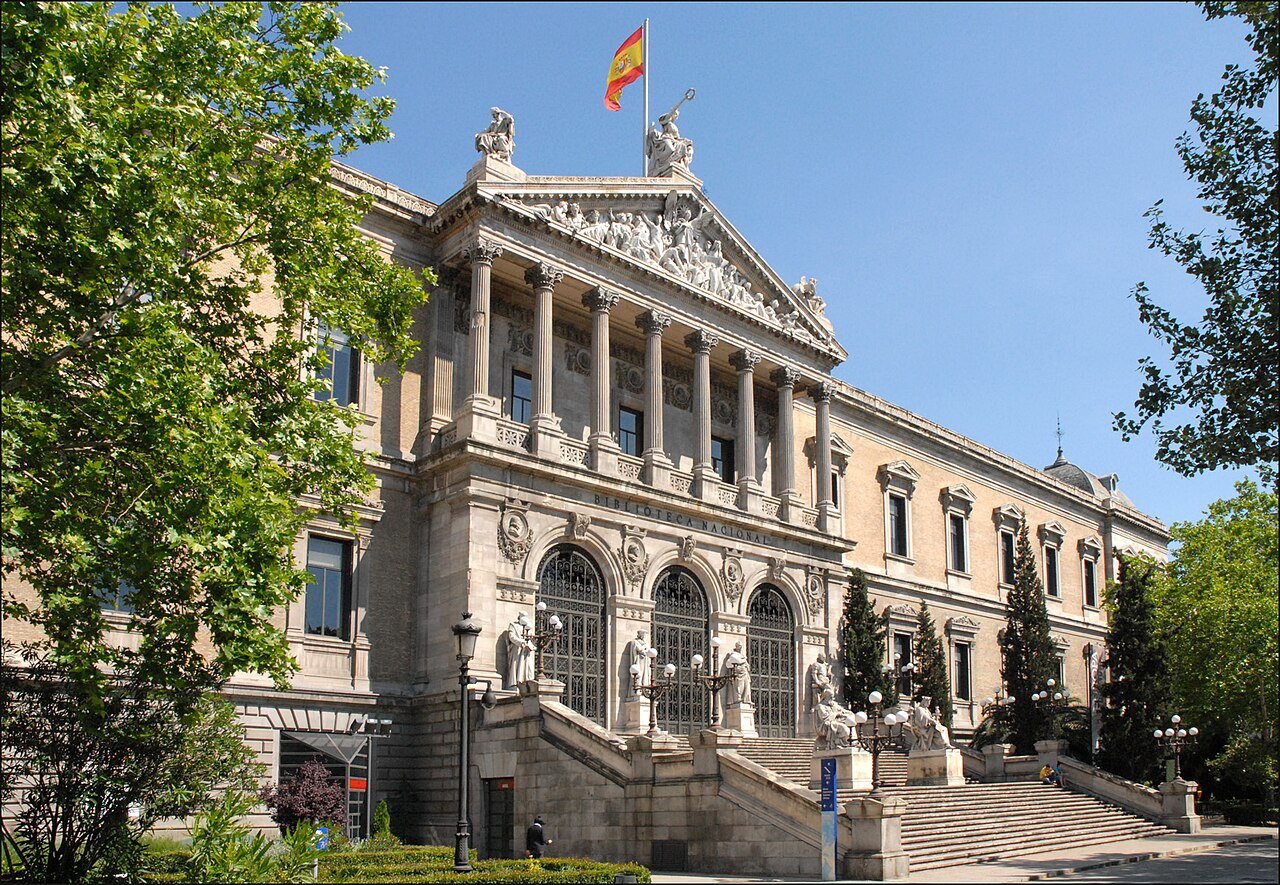
The National Library Building in Madrid
The National Library of Spain’s main building is located in Madrid.
The building is one of the city’s important cultural landmarks.
Its architecture reflects the institution’s historical importance and its connection with Spain’s cultural heritage.
The building houses reading rooms, research spaces, administrative facilities, exhibition areas, storage areas, and other specialized spaces.
The architecture of a major library must combine public access with the protection of valuable collections.
This creates special requirements for temperature, humidity, security, lighting, fire protection, and storage.
Library Architecture and Preservation
Historical books and manuscripts are sensitive materials.
Paper can deteriorate when exposed to excessive humidity, heat, light, pollutants, or poor storage conditions.
Modern library buildings therefore require carefully controlled environments.
Special collections may need additional protection.
Preservation specialists work to slow deterioration and protect materials for future generations.
This work may include:
- Conservation
- Restoration
- Cleaning
- Protective storage
- Environmental monitoring
- Digitization
- Emergency planning
Preservation is one of the most important responsibilities of the National Library.
The Library’s Role in Research
The National Library of Spain is especially important for academic and historical research.
Researchers can use its collections to study:
- Spanish history
- European history
- Literature
- Linguistics
- Art
- Music
- Geography
- Journalism
- Political history
- Social history
- Publishing
- Book history
- Cultural studies
Because the collections cover such a long period, researchers can compare materials from different centuries.
Services for Researchers
The library provides specialized services designed for researchers and readers.
Depending on the nature of the material and the user’s needs, researchers may consult catalogues, digital resources, reading rooms, reference services, and special collections.
Access requirements can vary depending on the type of collection.
Rare manuscripts and other valuable materials often require special handling procedures.
These rules exist to protect the materials while still making them available for legitimate research.
Exhibitions
The National Library of Spain organizes exhibitions that introduce important parts of its collections to the public.
Exhibitions are an important way of connecting specialized research collections with a wider audience.
A library exhibition may focus on:
- A famous author
- A historical period
- A literary work
- A scientific subject
- An artistic movement
- A historical event
- A particular type of document
- The history of books
Exhibitions can show original documents alongside explanatory material, helping visitors understand their historical context.
Educational Role
National libraries have an important educational mission.
The National Library of Spain contributes to public knowledge by providing access to information and cultural resources.
Students can use its resources for academic projects, while teachers and researchers can use the collections to support teaching.
Historical documents can make education more engaging because students can encounter primary sources rather than relying only on modern textbooks.
For example, studying an original historical newspaper can provide a different perspective from reading a later summary of the same event.
Cultural Heritage
The National Library of Spain is a major guardian of Spanish cultural heritage.
Cultural heritage includes more than monuments and buildings.
It also includes:
- Books
- Languages
- Literature
- Music
- Images
- Maps
- Newspapers
- Manuscripts
- Scientific knowledge
- Historical records
A society’s documentary heritage allows future generations to understand how earlier generations lived, thought, created, and communicated.
The National Library plays an important role in ensuring that this heritage survives.
Legal Deposit and National Publishing
Legal deposit is particularly important to the library’s national mission.
When publications are deposited with national institutions, future generations can access a record of what was published.
This makes legal deposit an important part of national bibliographic control.
It also supports the creation of comprehensive catalogues of national publishing.
In the digital age, this responsibility has become more complicated because publishers produce content in many different formats.
The national library must therefore address both printed and electronic publications.
Preservation of Spanish Language and Literature
The National Library is also important for the study of the Spanish language.
Historical books show how vocabulary, spelling, grammar, and literary styles changed over time.
Researchers can compare texts from different centuries to understand linguistic development.
The library’s collections also reflect Spain’s multilingual cultural environment.
Materials associated with different languages and cultural traditions represented within Spain contribute to a broader understanding of the country’s intellectual heritage.
International Importance
Although the National Library of Spain is a Spanish national institution, its significance extends far beyond Spain.
Spanish history has had a major influence on Europe, the Americas, Africa, and other parts of the world.
Spanish-language literature is read internationally.
Historical Spanish publications can therefore be valuable to researchers in many countries.
The library’s collections can support research into subjects such as:
- Spanish exploration
- Colonial history
- Latin American history
- Atlantic trade
- European diplomacy
- Hispanic literature
- Global cartography
- Religious history
The institution is consequently an important resource for international scholarship.
Importance for Hispanic Studies
Universities around the world have programs devoted to Spanish and Hispanic studies.
Researchers in these fields may need access to original Spanish-language materials.
The National Library of Spain provides a significant documentary foundation for such research.
Its collections can help scholars investigate the history of Spanish-language literature, publishing, politics, art, and culture.
Digital access has expanded this international role by allowing researchers to consult selected materials remotely.
The Library and the History of Books
The National Library is also an important institution for studying the history of books.
A book is not merely a container of words.
Its physical characteristics can reveal information about the society that produced it.
Researchers can study:
- Paper
- Binding
- Typography
- Illustrations
- Printing techniques
- Marginal notes
- Ownership marks
- Publishing practices
These features help scholars reconstruct the history of reading and publishing.
Rare Books
Rare books require specialized preservation.
Their age, scarcity, physical condition, and historical importance can make them particularly valuable.
Libraries must balance two responsibilities:
- Allowing researchers to study the material.
- Protecting the material from damage.
For this reason, rare books are often handled under strict procedures.
Digital copies can also help reduce unnecessary handling of fragile originals.
Conservation and Restoration
Conservation specialists work continuously to protect historical materials.
Books may suffer damage from age, insects, moisture, poor storage, or previous handling.
Restoration can involve carefully repairing damaged pages, bindings, or other components.
Modern conservation generally aims to preserve the historical integrity of an object rather than making it appear completely new.
The goal is to stabilize and protect the material so that it can survive for future generations.
Research Technology
Technology has transformed modern library research.
Researchers can now use online catalogues and digital databases to locate materials before visiting the library.
Digitized collections allow users to inspect documents on computers and other devices.
Search technology also makes it easier to discover materials that might otherwise remain hidden in large collections.
For a library with millions of items, effective cataloguing and digital discovery are essential.
Catalogues and Bibliographic Information
A national library needs detailed bibliographic records.
Cataloguing provides information about publications, including:
- Author
- Title
- Publication date
- Publisher
- Subject
- Language
- Edition
- Physical characteristics
Good bibliographic records help researchers locate relevant materials.
They also contribute to national bibliographic systems and international library cooperation.
The Library in the Digital Age
The role of national libraries has changed significantly because of the internet.
In the past, access depended heavily on physical travel.
Today, many resources can be accessed digitally.
However, digital transformation also creates new responsibilities.
Libraries must consider:
- Copyright
- Digital preservation
- Cybersecurity
- Metadata
- Long-term storage
- Online accessibility
- Digitization standards
The National Library of Spain must manage these challenges while continuing its traditional preservation work.
Copyright and Access
Not every item in a library collection can necessarily be placed online.
Copyright law affects how modern works can be digitized and distributed.
Older works may be in the public domain, making digital access easier.
More recent publications may have copyright restrictions.
National libraries therefore need systems that balance public access with the legal rights of authors, publishers, and other rights holders.
Public Engagement
A modern national library must serve both specialists and the wider public.
Public exhibitions, educational programs, digital collections, publications, and cultural activities can help people understand the importance of documentary heritage.
Libraries are increasingly becoming cultural spaces rather than simply book-storage institutions.
Visitors can encounter historical documents, learn about Spanish culture, and participate in educational activities.
Why the National Library of Spain Matters
The importance of the National Library can be understood through several major functions.
1. Preservation
It preserves documentary materials for future generations.
2. Research
It provides resources for scholars working across many disciplines.
3. National Memory
Its collections document Spain’s intellectual and cultural development.
4. Education
Students and teachers can use its resources for learning.
5. International Scholarship
Its collections support researchers studying Spain and the Spanish-speaking world.
6. Digital Access
Digitization allows many materials to be accessed beyond the physical library.
7. Cultural Identity
The library helps preserve the written and visual heritage of Spain.
Challenges Facing the National Library
Like other major national libraries, the National Library of Spain faces a number of challenges.
Preserving Fragile Materials
Old books, manuscripts, photographs, and newspapers can deteriorate over time.
Managing Digital Material
Digital publications can be difficult to preserve because technologies and formats change.
Copyright
Modern works cannot always be made freely available online.
Storage
Large collections require extensive storage facilities and preservation infrastructure.
Technological Change
Libraries must continually update digital systems and research tools.
Public Accessibility
Institutions must find ways to make collections accessible while protecting valuable originals.
The Future of the National Library of Spain
The future of the National Library will likely involve an increasing combination of physical preservation and digital access.
The physical collections will remain essential.
Original manuscripts, rare books, maps, photographs, and other objects have historical value that cannot be completely replaced by digital copies.
At the same time, digital technology will continue expanding access.
More digitization can allow researchers around the world to discover Spanish documentary heritage.
Artificial intelligence and advanced search technologies may also influence how users discover information in large digital collections.
However, technological development must be combined with careful preservation, reliable metadata, and scholarly standards.
Importance of Digitization for Future Generations
Digitization can protect cultural heritage in several ways.
If an original document is fragile, researchers may be able to consult its digital version instead of repeatedly handling the physical object.
Digital copies can also be stored in multiple locations, reducing the risk of total loss from a single physical disaster.
Digitization also makes education more accessible.
A student in another country can potentially examine a historical Spanish document without traveling to Madrid.
This creates new possibilities for global education and scholarship.
National Library and Spanish Identity
Libraries contribute to national identity by preserving records of a country’s cultural development.
The National Library of Spain contains evidence of changing ideas, languages, artistic traditions, political institutions, scientific discoveries, and social life.
It does not represent one single moment in Spanish history.
Instead, its collections reflect centuries of development.
This makes the institution a kind of cultural memory system for Spain.
A Resource for Historians
Historians rely heavily on primary sources.
Primary sources can include newspapers, letters, maps, official documents, photographs, diaries, books, and other records created during the period being studied.
The National Library’s extensive holdings provide researchers with many such materials.
By comparing different sources, historians can develop more detailed understandings of historical events and social conditions.
A Resource for Writers and Literary Researchers
Writers and literary scholars can also benefit from the library’s collections.
Original editions can help researchers understand how literary works were published and received.
Manuscripts may reveal changes made during the writing process.
Historical reviews and newspapers can provide evidence of contemporary reactions to literary works.
Together, these resources make the National Library an important center for literary research.
A Resource for Art Historians
The library’s drawings, prints, photographs, illustrated books, and other visual materials can support art historical research.
Researchers can study artistic techniques, iconography, publishing, illustration, and the relationship between text and image.
Illustrated books are especially valuable because they combine literary and visual culture.
A Resource for Geographers and Map Researchers
Historical maps provide evidence of changing geographic knowledge.
They can show how territories were represented at different times and how cities, roads, borders, and coastlines were understood.
The National Library’s cartographic materials can therefore support research in geography, history, exploration, and urban studies.
The Library as a Symbol of Knowledge
Libraries have traditionally represented the preservation and sharing of knowledge.
The National Library of Spain embodies this idea on a national scale.
Its purpose is not simply to collect as many books as possible.
Its broader mission is to ensure that important documentary evidence remains available.
A book preserved today may become a crucial historical source hundreds of years later.
Visiting the National Library of Spain
The National Library’s main presence is in Madrid, one of Europe’s major cultural capitals.
Visitors interested in the institution can explore its exhibitions, cultural programming, digital resources, and public information.
Researchers should check the library’s official information before planning a visit because access requirements, opening hours, reader registration, and collection availability can vary.
Some materials may require advance arrangements.
The National Library and Madrid
Madrid contains many major cultural institutions, and the National Library forms an important part of the city’s cultural landscape.
Its location places it near other important cultural and educational institutions.
For visitors interested in Spanish history and culture, the library can form part of a broader cultural itinerary.
Madrid’s museums, archives, libraries, historic buildings, and universities collectively provide a rich environment for cultural research.
The Broader European Library Tradition
The National Library of Spain is part of a larger European tradition of national libraries.
Other European countries have major national institutions responsible for preserving their documentary heritage.
Examples include national libraries in:
- France
- Germany
- Italy
- Portugal
- United Kingdom
- Austria
- Poland
- Sweden
These institutions share many responsibilities, including preservation, cataloguing, legal deposit, research support, and digitization.
The National Library of Spain contributes to this international network of cultural heritage institutions.
Cooperation with Other Institutions
Large national libraries often cooperate with universities, museums, archives, publishers, cultural organizations, and international library networks.
Such cooperation can improve:
- Preservation
- Digitization
- Research
- Cataloguing
- Exhibitions
- Cultural exchange
International cooperation is particularly important for materials that cross national boundaries.
Books, manuscripts, maps, and other historical objects often have histories involving multiple countries.
The Importance of Professional Librarians
A major library depends on highly trained professionals.
Librarians, archivists, conservators, cataloguers, historians, digital specialists, technicians, and other professionals all contribute to the institution’s work.
Their responsibilities can include:
- Identifying materials
- Creating catalog records
- Preserving collections
- Assisting researchers
- Digitizing documents
- Managing databases
- Organizing exhibitions
- Protecting rare materials
The size and complexity of the National Library’s collections make professional expertise essential.
Preservation as a Long-Term Responsibility
One of the most important ideas behind a national library is long-term responsibility.
A library is not preserving materials only for today’s readers.
It is preserving them for people who may live decades or centuries in the future.
This changes how the institution approaches its collections.
A fragile manuscript might be used carefully today because it must remain available tomorrow.
A digital file must be stored in a way that allows future technologies to access it.
National libraries therefore think in terms of generations rather than short-term use.
The Role of the Library in Modern Society
Even in an age dominated by smartphones and online information, national libraries remain important.
The internet provides enormous quantities of information, but not all online information is reliable, stable, or preserved.
National libraries provide curated, organized, and professionally maintained collections.
They also preserve original historical materials that may never have existed digitally.
This makes them important institutions for trustworthy research and cultural memory.
Conclusion
The National Library of Spain, or Biblioteca Nacional de España, is one of Spain’s most important cultural institutions. Founded in the early eighteenth century as a royal library, it gradually developed into a national institution dedicated to preserving and providing access to Spain’s documentary heritage.
Its collections encompass an extraordinary range of materials, including books, manuscripts, early printed works, newspapers, maps, drawings, prints, photographs, music, and digital publications.
The library is especially important for the study of Spanish literature, language, history, art, geography, publishing, and cultural development. Its materials associated with major literary figures and historical periods provide valuable resources for scholars and students.
At the same time, the National Library has adapted to the digital age. Through digitization and online resources, it has made many historical materials accessible to users beyond Madrid and Spain. Digital initiatives such as the Biblioteca Digital Hispánica demonstrate how national libraries can combine traditional preservation with modern technology.
The institution also faces continuing challenges. Fragile physical materials must be protected, digital information must be preserved, copyright must be respected, and technological systems must continually evolve.
Despite these challenges, the fundamental mission remains consistent: to collect, preserve, organize, and provide access to documentary heritage.
The National Library of Spain is therefore much more than a building filled with books. It is a repository of national memory, a center for research, an educational resource, and a gateway to centuries of Spanish and international cultural history.
For anyone interested in Spain’s literature, history, language, art, publishing, or intellectual traditions, the National Library of Spain represents an extraordinary source of knowledge. Its collections connect the past with the present and help ensure that Spain’s documentary heritage remains available for future generations.
Frequently Asked Questions
What is the National Library of Spain?
The National Library of Spain, known in Spanish as the Biblioteca Nacional de España, is Spain’s principal institution for collecting, preserving, organizing, and providing access to the country’s documentary heritage.
Where is the National Library of Spain located?
The National Library of Spain is located in Madrid, Spain.
When was the National Library of Spain founded?
The institution was founded in 1712 as the Public Library of the Palace during the reign of Philip V.
What does the National Library of Spain contain?
Its collections include books, manuscripts, incunabula, maps, newspapers, magazines, prints, drawings, photographs, music materials, and digital publications.
Why is the National Library of Spain important?
It preserves an extensive record of Spain’s literary, historical, artistic, scientific, and cultural heritage and provides important resources for research and education.
Does the National Library of Spain have digital collections?
Yes. The library has developed digital resources, including the Biblioteca Digital Hispánica, through which users can access many digitized historical materials.
Can researchers use the National Library of Spain?
Yes. The library provides research services and access to collections under its applicable rules and requirements.
Does the library preserve rare books?
Yes. Its collections include rare and historically significant books, including early printed works.
Why are historical newspapers important?
Historical newspapers provide primary-source evidence about political, social, cultural, economic, and everyday life during particular periods.
What is the Biblioteca Digital Hispánica?
The Biblioteca Digital Hispánica is a digital collection that provides online access to selected materials from the National Library of Spain.
Is the National Library of Spain important for Spanish literature?
Yes. It contains extensive resources for studying Spanish literature and the history of Spanish-language publishing.
What is the library’s role in preservation?
Its role includes collecting, conserving, restoring, cataloguing, digitizing, and providing controlled access to documentary heritage.
How does digitization help the library?
Digitization can improve access, reduce handling of fragile originals, support research, and create additional digital copies of important cultural materials.
What can students learn from the National Library’s collections?
Students can research literature, history, art, geography, language, journalism, science, publishing, and many other subjects using primary and secondary sources.
SEO Keywords
Primary Keyword: National Library of Spain
Secondary Keywords:
- Biblioteca Nacional de España
- National Library of Spain history
- National Library of Spain collections
- National Library Madrid
- Spain national library
- Biblioteca Digital Hispánica
- Spanish national library
- National Library of Spain manuscripts
- National Library of Spain books
- National Library of Spain digital collections
- Spanish cultural heritage
- Libraries in Spain
- Famous libraries in Spain
- National library of Madrid
- Spanish literature library
Suggested SEO Meta Description
Discover the National Library of Spain, its history since 1712, remarkable collections, manuscripts, rare books, digital resources, exhibitions, research services, and role in preserving Spanish cultural heritage.